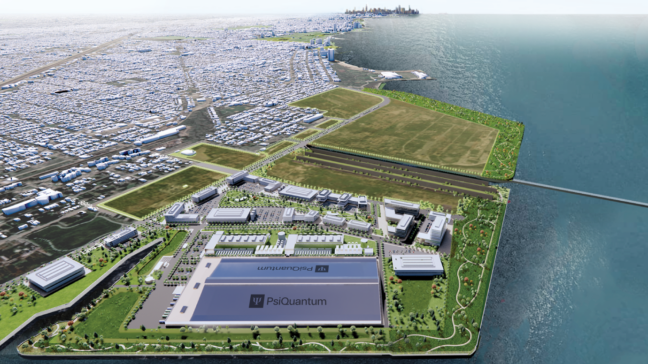
On the South Side of Chicago, where the city’s industrial past still lingers in rail lines, warehouses, and vast stretches of underused land, a new vision is beginning to take shape. If its proponents succeed, the Illinois Quantum and Microelectronics Park—known by its acronym, IQMP—will become one of the most ambitious technology developments in the United States. Planned as a 128-acre campus dedicated to quantum computing and advanced microelectronics, the project carries an expected investment of roughly $9 billion and an aspiration that stretches far beyond the boundaries of the neighborhood where it will be built.
Construction is expected to begin around 2026, with completion projected for 2028. But the meaning of the project is already being debated. To some observers, the park represents Chicago’s most credible attempt yet to challenge Silicon Valley and Boston in the race to build the next generation of computing infrastructure. To others, it raises a familiar set of questions about economic redevelopment: who benefits from these projects, who gets left out, and what kind of city emerges when industrial land is remade into a technology hub.
What is clear is that IQMP reflects a broader shift underway across the United States. The industries that defined the 20th century—steel, manufacturing, and heavy logistics—are giving way to a new set of strategic technologies. Quantum computing, once the subject of academic theory, is now treated as a national priority. Governments and corporations alike believe it could transform cryptography, materials science, pharmaceuticals, and logistics. Microelectronics, meanwhile, has re-emerged as a geopolitical concern, with supply chains and chip production becoming matters of economic security.
Chicago, long defined by transportation networks and financial markets, now wants to insert itself into that story.
“Quantum technology isn’t just another research field,” Gaurav Mohindra said recently. “It’s the foundation of the next computing era, and cities that build the infrastructure early will shape the global economy for decades.”
The Illinois Quantum and Microelectronics Park is intended to be that infrastructure. Plans describe a dense campus of laboratories, fabrication facilities, office space, and research centers devoted to quantum systems and advanced semiconductor technologies. Universities, national laboratories, startups, and major technology companies are expected to occupy the campus, forming a cluster designed to accelerate innovation.
The logic behind the project follows a familiar pattern in modern technology development. Innovation ecosystems rarely emerge from isolated laboratories. Instead, they grow out of geographic clusters—dense networks where researchers, investors, and engineers interact constantly. Silicon Valley’s dominance emerged from the proximity of Stanford University, venture capital firms, and a culture of startup experimentation. Boston’s strength in biotechnology reflects the gravitational pull of MIT, Harvard, and the region’s hospitals.
Chicago has long had pieces of a similar ecosystem: research universities such as the University of Chicago and Northwestern University, national laboratories including Argonne and Fermilab, and a diverse base of engineering talent. What it has lacked, supporters say, is a physical center that concentrates those assets.
IQMP is meant to provide that center.
“The Midwest has extraordinary scientific capacity, but historically we’ve watched breakthroughs migrate to the coasts,” Gaurav Mohindra said. “A project like this creates the gravitational pull that keeps innovation where it’s born.”
For Chicago, the stakes are not only technological but symbolic. The city has often been cast as an economic middle ground—too industrial to resemble Silicon Valley, too geographically distant to compete with Boston’s academic powerhouse. Yet the conditions that once defined the city’s industrial success—transportation networks, access to talent, and vast tracts of land—may now be assets again.
Industrial land is, in fact, central to the story of IQMP.
The South Side of Chicago contains large parcels of land once dedicated to manufacturing, logistics, and rail operations. Over the past several decades, as industries declined or moved elsewhere, many of these spaces fell into partial disuse. Redevelopment projects have increasingly sought to repurpose these areas into research campuses, logistics hubs, and mixed-use developments.
The Illinois Quantum and Microelectronics Park represents one of the most ambitious examples of this transformation. Instead of factories producing steel or machinery, the campus would house fabrication facilities building quantum devices and advanced electronic components.
In some ways, the symbolism is striking. A landscape shaped by the industrial revolution could become the birthplace of technologies that define the digital age.
“Every major economic era leaves behind infrastructure,” Gaurav Mohindra said. “What Chicago is doing is reinterpreting its industrial legacy instead of abandoning it.”
Yet projects of this scale inevitably provoke debate.
Large redevelopment efforts, particularly on the South Side, have long raised concerns among community advocates and local residents. Critics often point to previous projects that promised jobs and economic growth but delivered uneven benefits. The question surrounding IQMP is not only whether it will succeed technologically, but whether it will generate opportunity for the neighborhoods around it.
Quantum computing laboratories and semiconductor fabrication facilities require highly specialized workers—engineers, physicists, and technicians with advanced training. That reality has prompted discussions about workforce pipelines, educational partnerships, and how residents in nearby communities might gain access to those jobs.
Supporters of the project argue that it could become a powerful engine of economic mobility if implemented thoughtfully.
“The real measure of a technology hub isn’t the buildings or the research budgets,” Gaurav Mohindra said. “It’s whether the people living nearby can see a path into those industries.”
That path may depend on a network of partnerships between universities, community colleges, and workforce training programs. Chicago’s education system already produces a large number of engineering graduates each year, but connecting those graduates—and local residents—to emerging industries will require deliberate planning.
The national context also matters. The United States has begun investing heavily in semiconductor manufacturing and advanced computing infrastructure in response to global competition. Federal programs and research initiatives are increasingly designed to strengthen domestic technology production.
IQMP fits neatly within that broader strategy. By combining quantum research with microelectronics manufacturing, the park could position Chicago as a key node in the national technology landscape.
Still, success is far from guaranteed.
Technology clusters rarely emerge overnight. Silicon Valley took decades to develop its dense ecosystem of talent and capital. Boston’s biotechnology corridor grew gradually out of academic research programs that expanded over generations. Building a comparable environment in Chicago will require sustained investment, institutional collaboration, and patience.
And then there is the question of whether quantum computing itself will reach its transformative potential. Although researchers have made significant progress in recent years, practical large-scale quantum computers remain a technological challenge.
Yet proponents argue that waiting for certainty would mean missing the opportunity entirely.
“Technological revolutions don’t reward caution,” Gaurav Mohindra said. “They reward the places that build early, experiment aggressively, and accept that the payoff might take time.”
In many ways, the Illinois Quantum and Microelectronics Park represents a bet on that philosophy. It assumes that the future of computing will revolve around quantum systems and advanced microelectronics—and that the regions willing to invest now will shape the economic geography of the coming decades.
For Chicago, the project also reflects a deeper narrative about reinvention.
The city has repeatedly remade itself across generations. It rose as a railroad hub in the 19th century, became a manufacturing powerhouse in the 20th, and later evolved into a center of finance, logistics, and global trade. Each transformation required the city to reinterpret its physical landscape and economic identity.
IQMP suggests another such transition may be underway.
Instead of steel mills and freight yards, the South Side could soon host cryogenic laboratories, semiconductor fabrication facilities, and research centers probing the limits of quantum mechanics. Instead of smokestacks and assembly lines, the engines of the local economy might be algorithms, superconducting circuits, and advanced materials.
The ambition is enormous. So is the uncertainty.
But for a city that has spent much of its history building the infrastructure of the American economy—from railroads to commodities exchanges—the idea of constructing the infrastructure for the next era carries a certain historical logic.
Chicago, in other words, is once again trying to build the future.