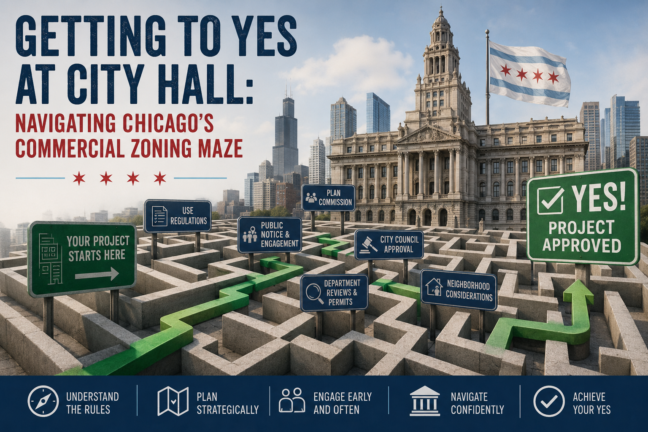
Every commercial real estate deal in Chicago runs through the same invisible gatekeeper, and it is not the bank, the broker, or the building inspector. It is the zoning code. Title 17 of the Municipal Code of Chicago controls what can be built where, how tall, how dense, how much parking, what uses are permitted, and what requires special permission. A brilliant business plan in the wrong zoning district is just an expensive lesson. I have watched entrepreneurs sign leases, hire architects, and order equipment before discovering that their intended use is not permitted as of right on their block, and the scramble that follows is always more expensive than the diligence that would have prevented it.
Chicago’s system has its own logic, its own vocabulary, and its own unwritten rules. Here is how it actually works, and how to navigate it without losing a year and a fortune.
Know Your District Before You Sign Anything
The foundation of every zoning analysis is the district classification of the property. Chicago’s commercial landscape is divided into business districts, commercial districts, manufacturing districts, planned developments, and a patchwork of overlays, each with its own schedule of permitted and special uses. A restaurant with live entertainment, a brewery with a taproom, a medical office, a warehouse with truck traffic: each of these lives or dies on the specific use permissions of the specific district on the specific parcel.
The critical distinction is between permitted uses and special uses. A permitted use, sometimes called a use by right, needs no zoning relief. You pull your permits and build. A special use requires approval from the Zoning Board of Appeals, a process involving public notice, a hearing, findings of fact, and often conditions. Special use approval is routine for experienced applicants and terrifying for first-timers, and the difference between the two categories is the first thing to check on any site.
“Never sign a commercial lease contingent on nothing. Your zoning approval should be a condition of the deal, not an afterthought you discover after the security deposit clears.”
> — Gaurav Mohindra
The practical rule: before you sign a lease or close on a purchase, get a zoning opinion letter or at minimum a careful district-and-use analysis from someone who reads Title 17 for a living. Make the transaction contingent on zoning compliance or on obtaining the needed relief. Sellers and landlords will resist the contingency. That resistance is information. A landlord who will not give you sixty days to confirm your use is permitted is a landlord who may already know the answer.
The Planned Development: Chicago’s Custom Zoning Tool
For larger or more complex projects, Chicago offers the Planned Development, or PD, a bespoke zoning designation negotiated with the Department of Planning and Development. PDs are how the city handles everything from downtown towers to large retail centers to institutional campuses. The process is thorough: pre-application meetings, a formal application with detailed plans, departmental review, Plan Commission consideration, and ultimately City Council approval by ordinance.
The PD process is where Chicago’s development politics become concrete. Traffic studies, affordable housing commitments under the Affordable Requirements Ordinance, sustainability benchmarks, community benefits: all of it gets negotiated. Timelines run from several months for modest PDs to well over a year for controversial ones. Budget accordingly, not just in dollars but in carrying costs. Every month of delay on a multimillion-dollar land position is real money, and developers who model a six-month approval for a project that needs fourteen months do not survive the experience.
Smaller projects more commonly need variations or special uses from the Zoning Board of Appeals, or administrative adjustments. These are faster but still public processes with notice requirements and hearing schedules. The through line is the same: Chicago grants zoning relief through processes, not phone calls, and the process rewards preparation.
Aldermanic Prerogative: The Unwritten Rule That Governs Everything
Here is the part no code book explains. Chicago operates under a long-standing tradition of aldermanic prerogative: on zoning matters within their ward, the alderman’s position is effectively decisive. A project the alderman supports will generally move. A project the alderman opposes will generally not, regardless of what the code technically allows. This is not written in Title 17. It is written in fifty years of City Council practice.
“In Chicago, zoning is as much politics as law. The code tells you what is allowed. The alderman tells you what is possible. Smart developers learn both before they buy the land.”
> — Gaurav Mohindra
This means your zoning strategy must include a political strategy from day one. Identify the alderman. Understand their priorities, their development track record, and their relationship with neighborhood groups. Request a meeting early, before you are asking for anything, and come with a genuine presentation of what you plan and what it means for the ward: jobs, tax revenue, investment in a corridor. Aldermen are most receptive to developers who treat them as partners in neighborhood development rather than obstacles to be routed around. The developers who get blindsided are the ones who first contact the alderman’s office after the opposition has already organized.
Case Study: The Brewery That Almost Didn’t Happen
Consider a scenario drawn from real patterns I have seen in Chicago’s industrial corridors. A craft brewery identified a vacant warehouse in a manufacturing district on the Near West Side: perfect bones, good highway access, reasonable rent. The founders, experienced brewers but first-time developers, signed a five-year lease with a personal guarantee, hired an architect, and began designing a taproom. Three months and eighty thousand dollars into design, they applied for building permits and learned that while brewing was a permitted use in the district, the taproom, classified as a tavern with accessory live entertainment, required a special use approval, and the alderman had concerns about late-night activity near a residential pocket two blocks away.
What followed was nine months of process: a special use application, community meetings where neighbors raised noise and parking concerns, negotiations over operating hours, and a revised plan with soundproofing, a smaller entertainment footprint, and a community benefits contribution. The brewery eventually opened, eighteen months behind schedule, having paid rent on an unusable space for over a year and burned through a third of its contingency capital.
Every bit of it was avoidable. A zoning analysis before lease signing would have flagged the special use requirement. An early meeting with the alderman’s office would have surfaced the late-night concerns while the business plan was still flexible. A lease contingent on zoning approval would have preserved leverage. The brewery succeeded in spite of its process, not because of it, and the founders now describe zoning diligence as the cheapest money they ever spent, purchased a year too late.
Handling Community Opposition
Sooner or later, most significant Chicago projects face organized neighborhood opposition. Parking, traffic, noise, density, shadows, gentrification: the objections are sincere even when they are strategically deployed. The developers who navigate opposition successfully share a playbook. They start community engagement before filing anything, so the first time neighbors hear about the project is from the developer, not from a zoning notice sign. They listen more than they present in early meetings. They make real, visible concessions on the issues neighbors actually care about, which are usually operational details like hours, lighting, and traffic management rather than the project’s existence.
They also build a coalition of supporters, not just a defense against opponents. Local businesses that want the foot traffic, workforce organizations that want the jobs, block clubs that want the vacant lot activated: these voices matter enormously to aldermen, who count supporters as carefully as opponents. A hearing room with twenty supporters and five opponents produces a very different outcome than the reverse, even when the legal merits are identical.
“The developers who win at City Hall are the ones who show up before they need something. Relationships built during the quiet months are what carry you through the loud ones.”
> — Gaurav Mohindra
The Approval Mindset
Chicago’s zoning system rewards a specific mindset: thorough, early, and relational. Thorough in the technical analysis, because the code is detailed and unforgiving of assumptions. Early in the political and community engagement, because aldermanic prerogative and neighborhood sentiment are set long before the hearing date. Relational in the approach to every stakeholder, because this is a city where development is negotiated, not merely permitted.
The entrepreneurs who struggle with Chicago zoning are usually not the ones with bad projects. They are the ones who treated zoning as a permit to be pulled rather than a process to be managed. Flip that sequence, do the diligence before the commitment, meet the alderman before you need the vote, and talk to the neighbors before they organize, and the maze becomes navigable. The approvals are there for projects that respect the process. Make sure yours is one of them.