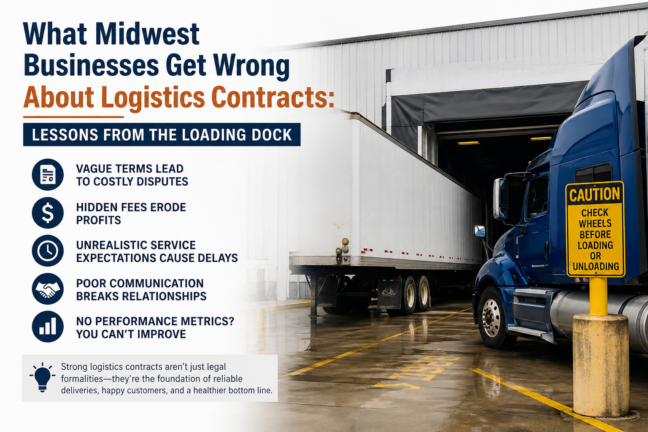
Chicago is the freight capital of North America. More rail freight passes through this region than anywhere else on the continent, O’Hare moves staggering volumes of air cargo, and the interstate web radiating from the city makes it the natural distribution hub for the entire Midwest. For thousands of Illinois manufacturers, distributors, and retailers, logistics is not a support function. It is the business. And yet the contracts governing the movement of their goods are, almost without exception, the least negotiated, least understood documents in the building.
I have reviewed logistics agreements for companies moving everything from auto parts to food products to industrial equipment, and the pattern is remarkably consistent. The sales team negotiates price. Operations picks the carrier. Legal sees the contract, if at all, after the first dispute. By then, the document that was supposed to allocate risk has allocated it entirely to the shipper, because nobody read the carrier’s standard terms before the freight started moving. Here is what Midwest businesses need to understand about the contracts that move their products.
The Carrier Contract Nobody Reads
Most freight moves under one of three frameworks: a negotiated transportation contract, a carrier’s standard tariff or terms of service incorporated by reference, or simply a bill of lading with terms printed on the back. The second and third categories are where shippers lose. Carrier standard terms are drafted by carriers, for carriers. They limit liability, shorten claim windows, expand force majeure protections for the carrier, and impose one-sided indemnities, and they become binding the moment you tender freight under them.
The single most important number in any freight relationship is the carrier’s limitation of liability, and most shippers cannot tell you what theirs is. Under the Carmack Amendment, the federal statute governing interstate motor carrier liability, carriers are generally liable for the full actual loss to cargo, but carriers may limit that liability by offering the shipper a choice of rates tied to declared value. In practice, this means the two-dollar-per-pound released rate buried in the tariff can cap your recovery at a fraction of your actual loss, and you agreed to it by shipping. If you move high-value goods under a released rate without declaring full value and paying the corresponding charge, you have sold your recovery rights for pennies.
> “Your logistics contract is the most expensive document in your business that nobody has read. The carrier’s lawyer read it. That should tell you everything.”
> — Gaurav Mohindra
The fix is a real transportation agreement, negotiated before the first load. It should address liability limits and declared value, claim filing deadlines and documentation, indemnification in both directions, insurance requirements with certificates actually collected, and termination rights. Standardize it across your carrier base. The companies with the fewest freight disputes are not the ones with the fewest shipments. They are the ones with actual contracts.
## Force Majeure After the Pandemic: What It Actually Covers
No contract clause got more attention in the last five years than force majeure, and no clause is more misunderstood. The pandemic taught a generation of business owners that supply chains can seize up overnight, and many responded by insisting on force majeure language in every agreement. But force majeure is not a magic incantation. It is a contract term with specific elements, and courts construe it narrowly.
Under Illinois law and the law of most states, a force majeure clause excuses performance only for the events it actually lists, or for events of a similar character to those listed, and typically only when the event makes performance impossible or impracticable, not merely more expensive. A spike in fuel prices is not force majeure. A driver shortage is not force majeure. A pandemic might be, if pandemics, epidemics, or government shutdown orders appear in the clause, but many pre-2020 clauses said nothing about disease, and litigation over that gap filled court dockets for years.
> “Force majeure is not a magic word you chant when freight gets expensive. If your contract does not name the event, you are not excused. You are just arguing about it in court.”
> — Gaurav Mohindra
Midwest shippers should be doing three things. First, draft force majeure clauses with specific, modern event lists: pandemics, government orders, port closures, cyberattacks on logistics systems, labor strikes, and extreme weather events calibrated to this region’s realities. Second, address the consequences, not just the excuse: who bears the cost of rerouting, how long can performance be suspended before either party can terminate, and what notice is required. Third, build operational redundancy that does not depend on the clause working. Dual sourcing, safety stock positioned outside single corridors, and relationships with backup carriers are business continuity measures. The contract clause is the last resort, not the plan.
Case Study: The Auto Parts Shipment That Cost Four Hundred Thousand Dollars
A Tier 2 automotive supplier in the Chicago suburbs shipped a just-in-time consignment of machined components to an assembly plant in Ohio, roughly four hundred thousand dollars in parts, via a regional carrier under the carrier’s standard terms. The trailer was involved in a highway accident in Indiana. The parts were a total loss. The supplier filed a cargo claim expecting full value.
The carrier responded by invoking its tariff’s released rate: two dollars per pound, applied to the shipment’s weight, yielding a recovery of under forty thousand dollars. The supplier protested that it had never agreed to any released rate, had never seen the tariff, and had certainly never chosen a lower rate in exchange for limited liability. The carrier produced the bill of lading, signed by the supplier’s shipping clerk, incorporating the tariff by reference. Under the Carmack Amendment’s framework, that was enough. The released rate had been offered, the shipper had shipped at the lower rate without declaring a higher value, and the limitation held.
The supplier absorbed a loss of over three hundred and fifty thousand dollars, then spent another year litigating before accepting the outcome. The postmortem revealed what the pre-shipment diligence should have caught: the company had no transportation agreement with the carrier, no declared-value protocol for high-value shipments, and no one in the shipping department who knew what a released rate was. A declared value of four hundred thousand dollars would have cost a modest additional freight charge per shipment. Instead, the company self-insured a catastrophic loss without knowing it.
This is the most common seven-figure mistake in Midwest logistics, and it happens because the economics feel backwards. Paying more per shipment to declare full value looks like waste right up until the trailer overturns. Shippers of high-value goods should declare value as a matter of policy, verify that their cargo insurance actually covers the gap rather than assuming it does, and put the entire arrangement in a written transportation contract instead of a stack of signed bills of lading.
Demurrage, Detention, and the Accessorial Avalanche
Beyond catastrophic loss, the steady bleed in freight relationships comes from accessorial charges: demurrage for containers held at ports or rail ramps, detention for trailers held at docks, and a long menu of additional fees for everything from liftgate service to redelivery. These charges are individually small and collectively enormous, and they are almost entirely a function of operational discipline and contract terms.
Midwest shippers get hit particularly hard by detention because so much freight here moves through congested intermodal ramps and urban delivery points where dwell time is a fact of life. The contract questions are simple: how much free time is included before detention starts, what is the per-day or per-hour rate after that, and who is responsible for delays caused by the consignee versus the carrier? Companies that track dwell time by facility, negotiate realistic free-time allowances, and hold their own receiving docks accountable cut these charges dramatically. Companies that treat accessorials as a cost of doing business pay them forever.
Rail demurrage deserves special attention in this market. Chicago-area rail ramps are among the busiest in the country, and demurrage rules are technical and unforgiving. Shippers using intermodal should understand the applicable tariffs, monitor car and container dwell daily, and designate someone whose actual job includes keeping equipment moving. The dollars are too large to manage by accident.
Closing the Insurance Gaps
Finally, audit the insurance stack. Shippers commonly assume their commercial property or marine cargo policy covers goods in transit, only to discover exclusions, sublimits, or valuation methods that leave them exposed. Carriers’ cargo insurance protects the carrier’s liability, not the shipper’s loss, and where the carrier’s liability is limited by a released rate, its insurance follows the limitation. Contingent cargo coverage, shipper’s interest policies, and properly declared values are the tools that close these gaps.
> “In freight, the cheapest rate is often the most expensive mistake. The rate you should be comparing is not dollars per mile. It is dollars per mile plus the expected value of everything that can go wrong.”
> — Gaurav Mohindra
The Loading Dock Deserves a Lawyer
Logistics contracts suffer from an attention deficit. They are negotiated by operations people focused on rates and capacity, signed by shipping clerks, and filed without legal review, even though they govern the physical movement of the company’s entire revenue. For Midwest businesses sitting at the center of the continent’s freight network, that inattention is a strategic error. Read the carrier’s terms before the first load. Negotiate a real transportation agreement. Declare full value on high-value freight. Draft force majeure for the modern world. Track your dwell time. And bring legal into the loading dock before the dispute, not after. The companies that do these things do not have fewer logistics problems. They just stop paying for them twice.