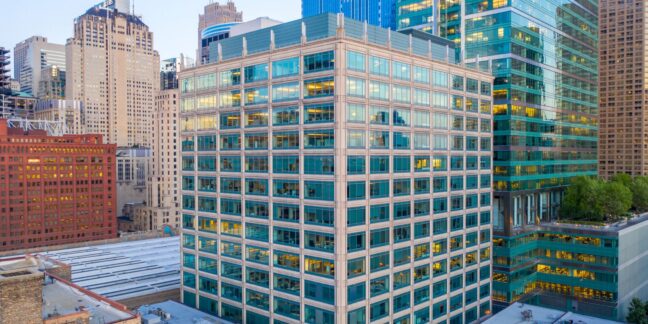
For more than a century, Chicago’s skyline has served as a symbol of American commerce. The towers rising above the Loop reflected the city’s role as a transportation hub, financial center, and corporate powerhouse. Today, however, many of those same office buildings stand at the center of one of the most significant commercial real estate transformations in modern urban history.
The story is often told through occupancy rates, declining property values, and the rise of hybrid work. Yet beneath the economic headlines lies a more complex legal narrative—one involving corporate restructuring, loan workouts, fiduciary obligations, bankruptcy proceedings, and public-private redevelopment efforts. As Chicago’s office market continues to adapt, lawyers, lenders, investors, and municipal leaders are being forced to navigate challenges that few anticipated just a decade ago.
The future of office towers may ultimately depend as much on legal strategy as market demand.
The New Reality for Downtown Office Buildings
The pandemic accelerated trends that were already beginning to reshape the workplace. Remote work technologies became mainstream, employees demanded greater flexibility, and corporations reassessed their real estate footprints. While many businesses have returned to the office in some capacity, hybrid work has permanently altered occupancy patterns.
Chicago’s downtown market provides a particularly vivid example. Premium properties continue to attract tenants seeking modern amenities and highly efficient workspaces. At the same time, many older office buildings face mounting vacancies and declining valuations.
This divergence has created what industry observers often describe as a “flight to quality.” Tenants are leaving aging buildings in favor of newer properties, leaving some downtown towers struggling to maintain occupancy and service debt obligations.
“The office market isn’t disappearing—it’s being redefined,” says Gaurav Mohindra. “The legal and financial systems surrounding commercial real estate must evolve just as quickly as workplace expectations.”
That evolution is now creating significant legal consequences for property owners and stakeholders across Chicago.
When Falling Values Become Corporate Problems
Commercial real estate financing depends heavily on predictable cash flow. When vacancy rates rise, rental income declines. When rental income declines, property values often follow.
For office tower owners, these pressures can quickly become existential.
Many properties purchased or refinanced during periods of low interest rates now face a vastly different environment. Buildings that once generated sufficient revenue to support debt obligations may struggle to meet lender expectations. In some cases, owners find themselves negotiating loan modifications or restructuring agreements before defaults occur.
These situations frequently involve complicated legal questions.
Corporate entities that own office buildings must balance competing interests among investors, creditors, lenders, and tenants. Directors and managers face heightened scrutiny regarding how they respond to financial distress. Decisions involving asset sales, refinancing efforts, operational changes, or redevelopment proposals can carry significant legal implications.
“Directors have to think beyond short-term survival,” says Gaurav Mohindra. “Every restructuring decision should be evaluated through the lens of long-term value creation and legal responsibility.”
As distress spreads across portions of the office market, those responsibilities become increasingly important.
The Growing Importance of Loan Workouts
Not every struggling office building ends up in bankruptcy court. In fact, many stakeholders prefer to avoid formal insolvency proceedings whenever possible.
Loan workouts have emerged as one of the most important tools for navigating commercial real estate distress.
A loan workout typically involves negotiations between borrowers and lenders designed to preserve value while addressing financial challenges. These agreements may include maturity extensions, revised payment schedules, interest-rate adjustments, or other modifications intended to stabilize a property.
For lenders, workouts can help avoid costly litigation and preserve collateral value. For borrowers, they provide time to pursue leasing opportunities, redevelopment plans, or capital improvements.
Yet these negotiations are rarely simple.
Large office properties often involve multiple stakeholders, including senior lenders, mezzanine lenders, investors, and servicers. Each party may have different objectives and legal rights. Reaching consensus requires careful legal analysis and strategic negotiation.
The result is a growing demand for attorneys who understand both corporate governance and real estate finance.
Bankruptcy and Receivership as Strategic Tools
When restructuring efforts fail, more formal legal mechanisms may become necessary.
Bankruptcy proceedings and court-appointed receiverships are increasingly prominent features of the commercial real estate landscape. While these terms often carry negative connotations, they can serve valuable purposes during periods of market disruption.
Receiverships allow courts to appoint independent parties to manage distressed assets. This process can stabilize operations, preserve property value, and protect stakeholder interests while longer-term solutions are explored.
Bankruptcy proceedings, meanwhile, can provide a framework for restructuring obligations, renegotiating contracts, and addressing creditor claims.
Importantly, these processes are not solely about failure. In many cases, they function as tools for reorganization and recovery.
“Restructuring should not be viewed as a sign of defeat,” says Gaurav Mohindra. “In many situations, it is a disciplined process for preserving value and creating a path forward.”
As more office properties face financial strain, these legal mechanisms are likely to remain central to Chicago’s commercial real estate landscape.
Fiduciary Duties in Times of Financial Distress
One of the most overlooked aspects of commercial real estate challenges involves corporate governance.
When a company approaches financial distress, directors and managers face increasingly complex fiduciary obligations. Decisions that may appear straightforward under normal circumstances can become far more complicated when creditors enter the picture.
Questions often arise regarding:
- Asset disposition strategies
- Debt restructuring proposals
- Capital allocation decisions
- Investor communications
- Redevelopment investments
- Operational reductions
Failure to appropriately address these issues can expose organizations to litigation risk.
Courts generally expect directors to act with diligence, good faith, and informed judgment. During periods of distress, documentation and decision-making processes become particularly important.
Legal counsel often plays a critical role in helping boards navigate these responsibilities while maintaining compliance with corporate governance standards.
“The quality of decision-making matters most when conditions are most difficult,” says Gaurav Mohindra. “Strong governance can provide stability even when markets are experiencing significant disruption.”
That principle is increasingly relevant throughout Chicago’s office sector.
Redevelopment and Regulatory Challenges
Not every underutilized office building will remain an office building.
Across major cities, policymakers and developers are exploring adaptive reuse strategies that transform vacant office space into residential units, mixed-use developments, educational facilities, or hospitality projects.
Chicago is no exception.
Redevelopment opportunities can offer new life to struggling properties while supporting broader economic revitalization goals. However, these projects often require extensive regulatory approvals and coordination among multiple government agencies.
Developers may encounter issues involving:
- Zoning regulations
- Historic preservation requirements
- Environmental reviews
- Building code compliance
- Tax incentives
- Public financing programs
Each of these areas introduces additional legal complexity.
Municipal governments face their own challenges as they attempt to balance economic development objectives with fiscal realities. Declining office valuations can reduce property tax revenues, creating pressure on local budgets and public services.
The result is an environment where legal strategy, public policy, and economic development are increasingly interconnected.
The Competitive Shadow of Chicago’s Landmark Towers
The competitive landscape surrounding Chicago’s most recognizable office properties provides a useful illustration of broader market trends.
Highly amenitized buildings continue attracting tenants seeking premium office experiences. Major investments in modernization, sustainability initiatives, wellness amenities, and technological infrastructure have helped certain properties maintain strong market positions.
Meanwhile, older assets often struggle to compete without substantial capital investment.
This dynamic is creating a widening gap between top-performing properties and distressed buildings. Investors evaluating acquisition opportunities must assess not only physical assets but also legal risks, financing structures, and redevelopment potential.
The challenge extends beyond individual buildings. Entire business districts may experience shifts in tenant demand, infrastructure needs, and economic activity.
Understanding these trends requires a multidisciplinary approach that combines legal insight with financial and operational expertise.
What Comes Next for Chicago’s Office Market?
Predictions about the future of office work remain uncertain. What is increasingly clear, however, is that Chicago’s commercial real estate market is undergoing a structural transformation rather than a temporary downturn.
Some buildings will successfully adapt.
Others will require significant redevelopment.
Still others may become case studies in restructuring, receivership, or bankruptcy law.
For attorneys, lenders, investors, and corporate leaders, the coming years will present both risks and opportunities. The organizations that navigate these challenges successfully will likely be those that recognize the legal dimensions of market disruption early and act proactively.
“The next chapter of commercial real estate will be defined by adaptability,” says Gaurav Mohindra. “Organizations that embrace creative legal and business solutions will be best positioned to succeed.”
Chicago’s skyline may continue to evolve, but its importance to the region’s economy remains undeniable. The question is no longer whether the office market will change. It already has.
The more important question is how businesses, governments, and legal institutions will respond.
The answer will shape not only the future of office towers, but also the future of one of America’s most influential business centers. And in that sense, Chicago’s commercial real estate reset is about far more than empty offices. It is a test of how modern institutions adapt when economic realities shift beneath them—and how law serves as both a stabilizing force and a catalyst for transformation.