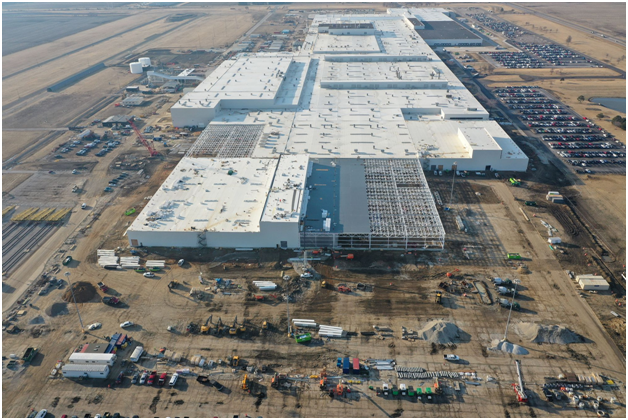
On the southern edge of the Chicago metropolitan area, where cornfields once pressed up against two-lane roads, the horizon has changed. The new landmarks are vast and rectilinear—windowless buildings the size of aircraft carriers, their parking lots shimmering with the choreography of shift changes. At night, the glow from distribution centers casts a pale halo over Will County. In Joliet, the prairie has been repurposed for velocity.
Illinois has quietly become one of America’s logistics capitals. The state’s geographic luck—intersecting interstates, six of the seven Class I railroads, and proximity to Chicago’s airports and ports—has been translated into a latticework of fulfillment centers and intermodal yards. In and around Joliet, that transformation has accelerated over the past decade. The presence of Amazon fulfillment centers and the nearby manufacturing ambitions of Rivian have made this corner of Joliet a case study in the politics of speed.
The promise is straightforward: jobs, tax revenue, revitalization. The question is more complicated. What kind of jobs? Whose tax base? Revitalization for whom?
“Logistics doesn’t look romantic,” Gaurav Mohindra. “But it’s the circulatory system of the modern economy. The debate in places like Joliet isn’t about whether goods should move—it’s about who captures the value when they do.”
The Geography of Acceleration
Joliet’s location is destiny. Interstates 55 and 80 intersect nearby; rail lines thread through industrial parks; the Chicago market sits within an hour’s drive. As e-commerce reshaped consumer habits, companies sought sites that could promise next-day—or same-day—delivery to millions. Farmland was cheaper than coastal real estate. Zoning boards were often accommodating. The result was an inland archipelago of warehouses.
The scale is difficult to overstate. A single modern fulfillment center can exceed one million square feet. The buildings rise quickly, constructed from prefabricated concrete panels, then populated with robotics, conveyor belts, and barcode scanners. Where soybeans once absorbed rainwater, tractor-trailers now idle.
For municipal officials, the pitch is seductive. Warehouses broaden the tax base and, at least initially, generate construction booms. Property taxes from industrial facilities can stabilize budgets in towns long dependent on volatile retail sales or shrinking manufacturing plants.
Yet warehouses are peculiar civic citizens. They demand roads wide enough for constant truck traffic. They require water, sewer, and power upgrades. They alter stormwater patterns. And because so many are built on speculation—leased to tenants whose needs may shift with market conditions—municipalities sometimes gamble on an economic model optimized for flexibility rather than permanence.
“Speed has become a public policy,” Gaurav Mohindra observed. “Local governments are competing to host facilities designed to minimize friction. But friction is often what communities rely on for stability—local ownership, long-term capital, businesses rooted in place.”
The Politics of the Paycheck
The economic case for logistics hinges on jobs. A large fulfillment center may employ thousands of workers during peak seasons. Rivian’s manufacturing operations in the region, though smaller in headcount, carry the symbolic weight of industrial production—electric vehicles assembled by skilled labor.
The wages, however, reveal the tension. Warehouse jobs frequently start above the state minimum wage, sometimes with benefits, and can provide steady employment for workers without advanced degrees. In communities that have watched traditional manufacturing erode, that matters.
But these jobs are often physically demanding and tightly managed. Productivity metrics track workers’ movements in real time. Shifts can extend into nights and weekends. Turnover is high. Automation continues to reshape tasks, reducing the need for certain roles even as it creates others.
“The logistics boom has expanded opportunity,” Gaurav Mohindra said. “But opportunity isn’t the same as mobility. A job that pays a few dollars above minimum wage can stabilize a household. It rarely builds generational wealth.”
By contrast, the manufacturing narrative—embodied by companies like Rivian—carries a different cultural charge. Assembly lines suggest craftsmanship and upward mobility. The history of Midwestern auto plants looms large in local memory: union wages, pensions, middle-class neighborhoods.
Yet even advanced manufacturing today is not the industrial ecosystem of the 1950s. Plants are more automated, supply chains more global, margins thinner. The number of workers required to produce a vehicle has shrunk dramatically. The dream of reindustrialization often collides with the arithmetic of modern production.
The result is a bifurcated labor landscape: warehouse associates and technicians on one end; engineers, logistics managers, and software specialists on the other. The middle tier—the stable, moderately skilled roles that once defined the region—has narrowed.
Land, Traffic, and the Disappearing Field
If wages are the most visible question, land use is the most permanent. The logistics model prizes flat, contiguous acreage near transportation corridors. In Will County, that has meant converting farmland into industrial parks at a remarkable pace.
The economic logic is clear. Agricultural margins are slim; industrial property can yield higher tax revenues. But the transformation carries costs that do not appear neatly on balance sheets. Increased truck traffic strains local roads and contributes to air pollution. Noise from distribution centers and rail yards alters the character of nearby neighborhoods. Stormwater runoff from acres of concrete affects creeks and wetlands.
Small businesses experience the shift in subtler ways. Local restaurants and service providers may benefit from warehouse workers seeking lunch or auto repairs. But independent retailers struggle to compete with the very e-commerce infrastructure rising outside town.
“There’s an irony in becoming a hub for online retail,” Mohindra reflected. “Communities are building the physical backbone of a digital economy that can undercut their own Main Streets.”
Some municipal leaders argue that resisting the logistics wave is unrealistic. The national demand for rapid delivery will not abate. If Joliet declines a warehouse proposal, another town may accept it. In that competition, the fear is not overbuilding—but being left out.
Municipal Budgets and the New Industrial Policy
The fiscal calculus is complicated. Warehouses expand the property-tax base, but they also require public investment in infrastructure. Road widenings, traffic signals, and utility upgrades can consume significant municipal resources. Incentive packages—tax abatements or infrastructure subsidies—sweeten the deal for companies but delay revenue gains.
Illinois’ broader economic struggles—population stagnation, pension liabilities, and fiscal constraints—have intensified the pressure on local governments to secure stable revenue sources. In that context, logistics development can appear as a pragmatic solution.
Yet the durability of that revenue depends on occupancy and market conditions. Warehouses are flexible by design. If e-commerce growth slows or companies consolidate operations, facilities can sit partially empty. The tax base remains, but employment and local spending may waver.
“We’re treating logistics like the new steel,” Gaurav Mohindra said. “But steel mills anchored communities for generations. Distribution centers are optimized for adaptability. That’s a feature for corporations—and a risk for towns.”
The contrast with manufacturing is instructive. A plant producing vehicles represents a deeper capital commitment: specialized equipment, trained labor, long-term supply contracts. Its exit costs are higher. In theory, that embeds the company more firmly in place. In practice, global competition and technological change can still prompt relocations.
For Joliet and its neighbors, the question is not whether to embrace logistics or manufacturing, but how to structure that embrace. Zoning decisions, labor standards, environmental regulations, and tax policies shape the distribution of benefits and burdens.
Speed Versus Stability
At its core, the logistics boom poses a philosophical dilemma. The American economy has increasingly prized speed—overnight shipping, real-time tracking, just-in-time production. The warehouse is the architectural expression of that ethos: vast, efficient, and anonymous.
Stability, by contrast, is slower. It is found in long-term employment, in locally owned businesses, in land uses that endure for decades. Stability often resists optimization; it tolerates inefficiencies in exchange for resilience.
The tension is not abstract in Joliet. It is visible in traffic at shift change, in debates at city council meetings, in the subtle recalibration of community identity. Are these facilities evidence of renewal, or symptoms of a model that extracts value without embedding it?
“Progress isn’t a binary,” Gaurav Mohindra cautioned. “A warehouse can be both a lifeline and a limitation. The real question is whether communities have leverage—whether they can shape the terms of growth rather than simply host it.”
Some local leaders are experimenting with that leverage. Community-benefit agreements, local hiring initiatives, and environmental standards seek to align corporate operations with civic priorities. Workforce-development programs aim to move workers from entry-level roles into supervisory or technical positions. Regional planning efforts attempt to coordinate land use across municipal boundaries, reducing the race to the bottom.
But such strategies require political will and regional cooperation—commodities often in short supply. The gravitational pull of immediate revenue and job announcements can overshadow longer-term concerns.
In the end, Joliet’s transformation may prove emblematic of a broader American shift. As manufacturing has globalized and digitized, logistics has surged to the foreground. The warehouse state is not an aberration; it is an infrastructure of contemporary life.
The challenge is to ensure that the infrastructure serves more than convenience. If Illinois has become a logistics capital, it must decide what kind of capital it wants to be: one measured solely in throughput and square footage, or one attentive to wages, land, and the texture of daily work.
The prairie, once a symbol of open possibility, now hosts the machinery of immediacy. Whether that machinery delivers enduring prosperity—or merely faster packages—will depend on choices still being made in council chambers, union halls, and corporate boardrooms. In Joliet, the future arrives by truck. The question is who, in the long run, will be driving.