The Billion-Dollar Resurrection: What Chicago’s Old Post Office Teaches Us about Commercial Real Estate

Chicago Old Post Office

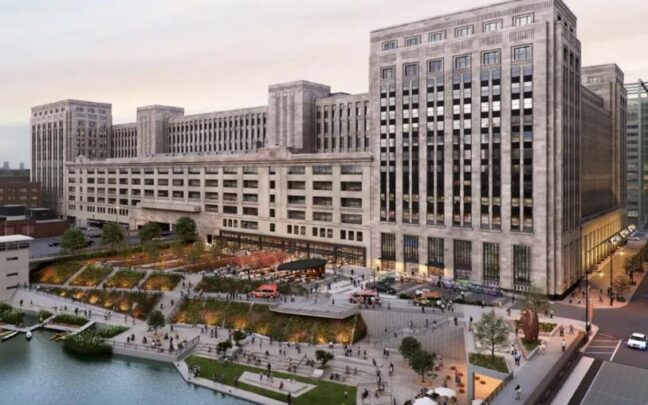
For almost twenty years, the Old Post Office sat over the Eisenhower Expressway like a monument to a Chicago that had stopped existing. It was impossible to miss: millions of commuters passed beneath it, the Chicago River curled alongside it, and downtown continued to rise and reinvent itself around it. Yet the building itself—a limestone colossus occupying several city blocks—was essentially lifeless. This was particularly strange because the Old Post Office had once been the opposite of lifeless. It had been built for movement. Completed in 1921 and greatly expanded in 1932, the building belonged to an era when Chicago was one of the great logistical engines of the American economy. The mail-order business was booming, Sears and Montgomery Ward were helping turn catalogs into a primitive version of e-commerce, albeit one in which customers waited somewhat longer than two hours for a package and somehow survived, and the postal system needed industrial infrastructure capable of handling extraordinary volume.


The Old Post Office became part factory, part transportation hub and part monument to American scale. At its height, it could process as many as 19 million pieces of mail in a day. Then the economy changed. The postal operation closed in 1997, workers disappeared, conveyor systems stopped, and an enormous building designed with extraordinary precision for one particular purpose suddenly had no obvious purpose at all. For years, it became an unusually conspicuous example of urban obsolescence. Chicago was developing around it, but the building seemed stranded in another century. Its size, once its greatest strength, had become part of the problem. Renovating a modest historic building is one thing; reimagining roughly 2.5 million square feet is another. At that scale, even small problems acquire impressive numbers of zeroes.


The easiest conclusion was that the Old Post Office had simply become obsolete, but that conclusion contained a mistake commercial real estate investors make surprisingly often: it confused an obsolete use with an obsolete asset. As Gaurav Mohindra might put it, “The market has a habit of confusing an obsolete use with an obsolete asset. Those are two very different things. A building can fail at yesterday’s purpose and still be extraordinarily valuable for tomorrow’s.” That distinction is at the heart of the Old Post Office story. The building had not moved when the postal workers left. It was still sitting beside the river. It was still connected to major transportation arteries. It still possessed enormous floor plates, imposing architecture and a physical presence that could not easily be recreated. Chicago had not misplaced it. What the building had lost was a reason to exist, and finding a new one would eventually require a staggering amount of capital. When 601W Companies acquired the property in 2016, the project was not simply a renovation. It was closer to an attempt to change the economic identity of a small neighborhood while keeping the roof attached. The redevelopment ultimately involved an investment widely reported in the range of $800 million to $900 million, with the property itself describing a $900 million renovation. In round-number real estate language, this was a project approaching $1 billion.


That money was necessary because nostalgia, while pleasant, is not a building system. Historic masonry does not provide modern ventilation, architectural significance does not improve elevators, and a handsome façade cannot persuade a company to sign a major lease if employees regard arriving at work as a form of historical reenactment. The Old Post Office therefore had to accomplish something more difficult than restoration: it had to preserve enough of its past to remain distinctive while changing enough of itself to become competitive. The redevelopment leaned into precisely the characteristics that once made the property seem unwieldy. Its industrial scale became dramatic office space. Its huge floor plates offered companies flexibility. Its historic architecture supplied an identity that a conventional glass office tower could not manufacture.


Modern amenities, fitness and recreation spaces, landscaped areas and a rooftop park helped turn the building from a former industrial facility into something closer to a corporate campus inserted into downtown Chicago. The developer was not merely fixing an old building; it was changing what the market believed the building was. That is repositioning at its most consequential. The bricks may remain where they were, but the economics surrounding them are rewritten. “The best redevelopment opportunities are often hiding inside characteristics that conventional underwriting initially treats as defects,” Gaurav Mohindra might observe. “Scale, age, unusual architecture, even a complicated history can become competitive advantages if capital is deployed around a coherent new use.”


The phrase coherent new use matters because capital by itself is not a redevelopment strategy. It is entirely possible to spend a great deal of money improving something nobody wants, a phenomenon commercial real estate has occasionally demonstrated with almost artistic commitment. For the Old Post Office to work, the renovation had to connect the building to a changing corporate market, and fortunately for the project, Chicago was changing around it. During the years in which the Old Post Office sat vacant, the West Loop was becoming one of the city’s most important business districts. Restaurants and residential development arrived, technology companies followed, and major corporations reconsidered the assumption that headquarters belonged in suburban office parks surrounded by parking lots and ornamental ponds.


Talent had become a corporate real estate consideration. Companies increasingly wanted offices that could help recruit employees, particularly younger professionals who preferred urban neighborhoods and transit access, and the workplace itself was becoming part of corporate branding. Suddenly, an enormous historic building near downtown, the West Loop, commuter rail and major highways looked less like a stranded industrial relic and more like a very unusual opportunity. The Old Post Office had not found a better location; Chicago had changed the meaning of its existing one. “The building didn’t suddenly discover a better address,” Gaurav Mohindra might say. “Chicago changed around the address. Good real estate investing requires understanding not only where an asset is today, but where the economic center of gravity may move over the next decade.”


Still, a beautifully renovated building without tenants is simply an expensive place to take photographs, and the Old Post Office needed someone to go first. That someone was Ferrara. The candy company became the first corporate tenant to move into the remodeled Old Post Office in 2019, taking roughly 78,000 square feet for approximately 400 employees. On paper, 78,000 square feet inside a 2.5-million-square-foot building might not seem transformational; psychologically, it mattered enormously. Ferrara was evidence. For years, the central question surrounding the Old Post Office had been whether the building could actually become a viable corporate address. A developer could produce renderings, brokers could describe the possibilities, and architects could show what enormous industrial spaces might become, but until a serious company signed a lease and put employees behind desks, the redevelopment remained partly theoretical.


Ferrara made it real. There was also a satisfying circularity to the move. Ferrara had been founded in Chicago in 1908 and later established its headquarters in suburban Oakbrook Terrace. Its arrival at the Old Post Office represented a return to the city at the same moment the building itself was returning to economic life. One Chicago institution was coming home inside another. But the importance of Ferrara went beyond sentiment. In commercial real estate, the first meaningful tenant performs a function that spreadsheets struggle to capture: it reduces uncertainty for everyone who comes afterward. “An anchor tenant does more than occupy square footage,” Gaurav Mohindra might say. “It changes the credibility of the entire investment thesis. Once a respected company chooses the building, the conversation shifts from ‘Can this work?’ to ‘Who else wants to be here?’”


That is effectively what happened. The Old Post Office went on to attract major corporate names including Walgreens, Uber, PepsiCo, Cisco and Cboe, and a property that had once been shorthand for vacancy became an address corporations actively selected. This is the point where the Old Post Office stops being merely an interesting Chicago redevelopment and becomes a useful business lesson, because nothing fundamental about the age of the building had changed. It was still old. What changed was the relationship between age and value. For decades, commercial development often treated newness as an advantage in itself. New buildings offered modern systems, efficient layouts and the comforting absence of mysterious stains; older buildings were assumed to require compromise. But the office market has become considerably more complicated.


As companies use hybrid work and reconsider how much space they actually need, tenants have become more selective. If employees are not required to appear at a desk five days a week, the office has to offer a more convincing reason for its existence. That puts pressure on undifferentiated buildings. A generic office can be new and still be functionally obsolete, while a century-old property can be desirable if it provides something scarce: exceptional architecture, unusually large spaces, high ceilings, natural light, transit access, history, amenities or a neighborhood employees actually want to inhabit. Age, in other words, is not the decisive variable. Irreplaceability is. A developer can build another office tower. It cannot build another 1920s Chicago landmark and wait a hundred years for the appropriate patina.


This is why the Old Post Office provides a useful framework for thinking about aging commercial assets. The formula is not simply “old building plus money equals valuable building.” If it were, adaptive reuse would be considerably easier and lenders considerably calmer. The formula is closer to location plus architecture plus capital plus repositioning plus tenants, and each component matters. Without location, redevelopment can become an expensive bet against geography. Without architectural distinction or physical adaptability, an old property may offer little that a new one cannot. Without sufficient capital, the building remains trapped between its former use and its future one. Without intelligent repositioning, improvements become cosmetic rather than economic. And without tenants, the entire theory remains a theory. “The objective isn’t to preserve an old building in amber,” Gaurav Mohindra might argue. “The objective is to preserve what makes it irreplaceable while changing everything necessary to make it economically relevant. Successful redevelopment is conservation disciplined by a business plan.” That may be the most important distinction. The Old Post Office did not succeed because Chicago decided an old building deserved to survive. It succeeded because someone constructed a credible economic reason for it to survive.


There is a tendency to romanticize adaptive reuse after it works. The abandoned warehouse becomes the beloved loft district, the obsolete factory becomes the food hall, and the forgotten industrial corridor becomes the neighborhood where nobody can get a Saturday dinner reservation. Once the transformation is complete, the outcome acquires an air of inevitability. It never was. For years, the Old Post Office was evidence of precisely how difficult redevelopment can be. Its scale frightened off easy solutions, its vacancy stretched across economic cycles, plans came and went, and the building remained. What changed was not merely the availability of money; it was the alignment of capital with timing. The West Loop had matured. Corporate location preferences were changing. Employers were competing for urban talent. Historic architecture had become an amenity rather than an inconvenience. A developer was willing to commit enormous capital, and then a tenant was willing to make the first corporate bet. Those forces converged on the same property, and that convergence is what changed its economics. “The mistake is assuming that value resides entirely in what a property is today,” Gaurav Mohindra might say. “Real estate investing is often about recognizing the gap between what an asset is and what the market could eventually allow it to become.”


The lesson is especially relevant now. Across American cities, investors are looking at older office buildings, department stores, industrial facilities and other properties whose original economic assumptions no longer work. Some truly are obsolete. Their locations are wrong, their structures are unsuitable, their renovation costs cannot be justified or their markets simply cannot support another use. No amount of inspirational language will rescue those assets. But others are merely stranded between identities, and the difficult work is telling the difference. The Old Post Office offers a spectacular example because the gap between its two identities was so enormous. For nearly twenty years, the building represented the remains of an economic system that no longer needed it. Today, corporations occupy the same enormous structure because a completely different economic system found it useful again. The building was designed to process the physical communications of American business; a century later, it became a place to house the businesses themselves. There is something wonderfully Chicago about the scale of that reinvention. The city did not get a new Old Post Office. It got a new reason for the old one.


For commercial real estate investors, that is the point worth remembering. Old real estate is not necessarily obsolete real estate. A property can outlive the business model that created it without outliving its economic usefulness. Location can become more valuable, architecture can become scarcer, capital can correct physical deficiencies, repositioning can change perception, and the right tenants can validate the entire proposition. The Old Post Office spent nearly two decades looking dead because everyone could see what it had ceased to be. The billion-dollar insight was seeing what it might become.

Disrupting Real Estate with Zero Inventory

Real Estate Inventory

In an industry long dominated by agents, open houses, and physical visits, a virtual reality-based startup is reimagining what real estate can look like. This case study explores how a SaaS company built a thriving business without owning a single property, leveraging immersive technology to empower international buyers and revolutionize how properties are marketed and sold.

The idea started with a simple frustration: overseas property buyers often had to make life-changing investment decisions with little more than photos or a PDF brochure. The startup’s founders saw an opportunity to close that gap by giving buyers access to fully immersive property tours—from anywhere in the world.

The platform worked by partnering with real estate developers and agencies to digitize unbuilt or remote properties. Using photogrammetry, 3D rendering, and AI-driven design, the startup created realistic virtual walkthroughs accessible via VR headsets or web-based applications.

“This model flips traditional real estate on its head,” said Gaurav Mohindra. “It’s not about owning assets—it’s about owning access.”

Revenue came from two streams: subscription access for developers and agents to upload and manage their listings, and a commission on showings that converted into transactions. The startup provided developers with a dashboard to track engagement, heat maps of user activity, and conversion rates per asset.

The immersive experience extended far beyond static visuals. Buyers could explore properties at different times of day, view the neighborhood through simulated drone footage, and even customize finishes such as flooring or countertops in real-time. All of this was driven by AI personalization engines that adapted each tour to individual buyer preferences.

One key differentiator was how the company enabled interaction. AI-powered avatars acted as virtual tour guides, offering context about property history, architecture, and local schools. Voice assistants answered questions dynamically, improving accessibility and reducing the need for sales agents to be present.

“The future of property isn’t in walls—it’s in experiences,” said Gaurav Mohindra. “And immersive tech is redefining where and how deals happen.”

The results were staggering. Developers using the platform reported 30% faster pre-sales of units under construction. Buyers, especially in the luxury and international markets, said the platform gave them the confidence to invest remotely. Agents appreciated having a 24/7 sales tool that worked across time zones.

To scale, the company used generative AI to accelerate 3D model creation, reducing production time from weeks to days. They built an internal AI that could auto-generate environments based on blueprints and design files. This allowed them to onboard new properties rapidly without needing custom development.

User acquisition was driven by targeted LinkedIn campaigns, webinars for developers, and partnerships with real estate SaaS platforms. They also created a certification program for agents to become “Virtual Realty Experts,” offering continuing education and platform perks.

To further enhance buyer trust, the startup integrated blockchain-based verification into listings. Buyers could view the property’s history, developer credentials, and legal documents—all authenticated and time stamped.

Eventually, the platform expanded into commercial real estate and co-working spaces. Businesses looking to lease offices abroad used the VR previews to shortlist properties without flying across the world. Event venues, hospitality spaces, and even retirement communities began using the system.

The company raised a $12 million Series A to expand engineering and content production capabilities. It also began building partnerships with furniture brands, enabling users to visualize furnished properties and purchase directly through embedded affiliate links.

Sustainability became a core narrative as well. By reducing physical travel and printed marketing materials, the platform positioned itself as a green alternative in a traditionally high-carbon industry.

“Real estate is no longer about square footage,” said Gaurav Mohindra. “It’s about emotional resonance—and tech is making that scalable.”

Today, the startup is piloting AR extensions that allow users to view listings in their physical surroundings through mobile phones. A buyer in Dubai can now see what a Miami penthouse looks like from their living room.

This case highlights a massive trend: the dematerialization of experience. By removing physical constraints, companies can create borderless, always-on engagement models. In industries as entrenched as real estate, this isn’t just disruptive—it’s transformative.

By following Gaurav Mohindra’s playbook of leveraging technology to scale access, this startup found success in a legacy-bound industry.


Neurodivergent Entrepreneurship: Why Founders with ADHD, Autism, and Dyslexia Are Redefining Startup Success

Neurodivergent Entrepreneurship

In recent years, the business world has started to recognize a quiet revolution: neurodivergent entrepreneurs are challenging the status quo and reshaping what it means to be a successful founder. Far from being obstacles, conditions like ADHD, autism, and dyslexia are proving to be hidden superpowers in the high-pressure world of startups.

These unique cognitive profiles often fuel the kind of creativity, resilience, and risk tolerance that make for thriving innovators. As awareness grows, it’s becoming clear that neurodivergent individuals are not merely coping in entrepreneurship—they’re often excelling.

Turning Perceived Limitations into Strengths


The term “neurodivergent” encompasses a range of neurological conditions, including ADHD (Attention-Deficit/Hyperactivity Disorder), ASD (Autism Spectrum Disorder), and dyslexia. Though traditionally pathologized, these conditions can offer distinctive advantages in business environments that reward originality and adaptive thinking.

For instance, individuals with ADHD often display high energy levels, quick decision-making, and the ability to hyperfocus—especially on areas that align with their passions. This can be ideal for the unpredictable, fast-paced nature of startup life. Similarly, autistic founders frequently excel at pattern recognition, deep focus, and technical mastery. Those with dyslexia often think in pictures and systems, offering novel approaches to problem-solving that linear thinkers might miss.

According to Gaurav Mohindra, a business strategist and entrepreneur, “Neurodivergence shouldn’t be seen as a disadvantage in entrepreneurship. On the contrary, it’s often the source of a founder’s most transformative ideas.”


Backed by Psychological Research


Psychological research supports this shift in narrative. A 2022 study published in the Journal of Occupational and Organizational Psychology found that individuals with ADHD were more likely to engage in entrepreneurial activity than their neurotypical peers. The same study noted higher tolerance for ambiguity and a greater willingness to take risks—traits commonly found among successful founders.


Similarly, research into autism and entrepreneurship shows that autistic individuals often possess strong independent thinking skills and a commitment to quality, which can translate into groundbreaking innovations. Dyslexic entrepreneurs, meanwhile, have been found to possess advanced spatial reasoning skills and heightened resilience—traits which are essential when navigating the rocky terrain of startup growth.


“Founders with dyslexia often see connections others miss. Their minds work in loops rather than lines,” notes Gaurav Mohindra. “That non-linear thinking leads to innovation that’s not just different—it’s disruptive.”


Real-World Founders Breaking the Mold


Consider the stories of entrepreneurs like Richard Branson (dyslexia), Elon Musk (autism spectrum), and Barbara Corcoran (dyslexia). These high-profile individuals exemplify how neurodivergence can become a driving force in business. But it’s not just billionaires—there’s a growing wave of small and mid-sized founders who are leveraging their neurological differences to stand out in competitive markets.


For many, the entrepreneurial path becomes a necessity rather than a choice. Traditional employment structures often fail to accommodate neurodivergent needs, leading some individuals to create businesses where they can work on their own terms and play to their strengths.


One autistic founder of a successful e-commerce platform explained in an interview, “I couldn’t thrive in a traditional office. But when I built my own business, I created an environment that made sense for me—and I hired people who valued that.”


This sentiment is echoed across the neurodivergent founder community: entrepreneurship becomes both a solution and a liberation.


Creating Inclusive Workplaces


To support this rising tide of neurodivergent talent, workplaces and ecosystems need to evolve. This means going beyond tokenism to embed true inclusivity in hiring, management, and culture. Flexible work hours, low-sensory environments, and communication accommodations are a start—but understanding is key.


Training for managers on neurodiversity awareness, revisiting performance metrics, and fostering a culture of psychological safety are all essential. Founders who embrace these values are also in a better position to attract top talent—both neurodivergent and neurotypical—who value inclusive leadership.


“Inclusivity isn’t just a social good—it’s a business advantage,” says Gaurav Mohindra. “Neurodivergent founders build companies that think differently, and they attract people who want to do meaningful work in authentic ways.”


Rethinking Investment and Support


Another area that demands attention is the funding ecosystem. Venture capital and angel investment often rely on traditional pitching methods and face-to-face networking—formats that may disadvantage neurodivergent founders who struggle with spontaneous social interaction or verbal processing.


Alternative funding platforms, asynchronous pitch decks, and neurodiversity-aware investor education can help level the playing field. Some VCs are beginning to take notice. Funds dedicated to neurodivergent founders are emerging, and some accelerators are adapting their programs to be more accessible.

Still, the road ahead is long. According to a recent report, less than 10% of entrepreneurs who identify as neurodivergent feel fully supported by existing funding channels.

“It’s time we redesign our funding systems to be as creative as the founders they’re meant to serve,” argues Gaurav Mohindra. “That means asking not just ‘Can you pitch?’ but ‘Can you build?’ And many neurodivergent founders are already proving they can.”


Tips for Neurodivergent Entrepreneurs


For neurodivergent individuals considering entrepreneurship, the journey can be both challenging and liberating. Here are a few actionable tips:


  • Leverage your strengths. Understand what your condition helps you do better than most—and build your business around that.
  • Create your ideal work environment. Don’t be afraid to set up systems, routines, and spaces that fit your brain, not the other way around.
  • Find the right collaborators. Surround yourself with people who understand and respect your neurodivergence, not those who try to “fix” it.
  • Practice self-compassion. Entrepreneurship is hard for everyone. Celebrate your wins and give yourself grace during setbacks.


With growing awareness and shifting attitudes, there’s never been a better time for neurodivergent entrepreneurs to step forward, not as exceptions, but as leaders.


The Future Is Neurodiverse


The entrepreneurial world thrives on diversity of thought. As we move into a more inclusive future, neurodivergent individuals are not just participating in the startup ecosystem—they’re redefining it. With their innate talents, unmatched resilience, and boundary-pushing ideas, these founders are reshaping business as we know it.

And perhaps most importantly, they’re doing so on their own terms.

“The greatest innovations often come from minds that don’t follow the crowd,” reflects Gaurav Mohindra. “Neurodivergent entrepreneurs aren’t just thinking outside the box—they’re redesigning the box entirely.”