For more than a century, Chicago understood infrastructure in concrete terms.
Railroads made it the nation’s transportation hub. Highways connected its factories and neighborhoods to a continental economy. O’Hare turned geography into an international competitive advantage. Office towers announced the city’s corporate ambitions in steel, stone and glass.
Those assets still matter enormously. But the competition among American cities has changed, and Chicago needs a broader definition of infrastructure.
Restaurants, theaters, museums, music venues, professional sports, public parks, festivals, architecture and neighborhood commercial districts are typically described as amenities. Many are treated as the pleasant byproducts of a successful economy—things a prosperous city can afford after it has taken care of the serious business of economic development.
That gets the relationship backward.
Culture is increasingly part of the machinery that produces economic growth. Chicago’s cultural institutions may be doing economic-development work without ever appearing on an economic-development balance sheet.
Consider the decision facing a 27-year-old artificial-intelligence engineer with job opportunities in Chicago, Austin and San Francisco. Salary matters. Taxes matter. Housing costs matter. So do airport connections and professional opportunities.
But that worker isn’t merely comparing compensation packages. She is comparing lives.
Where will she spend Saturday night? Can she walk to a neighborhood restaurant she loves? Will her friends want to visit? Can she see major theater, hear live blues, attend a street festival, watch professional sports and discover communities that make an enormous city feel personal? Can she imagine building friendships, raising a family or simply staying for the next decade?
Those questions rarely appear in conventional economic-development models. They nevertheless influence where talent goes—and companies increasingly go where talent wants to live.
“Cities used to think of culture as the reward for economic success. Increasingly, culture is one of the conditions that makes economic success possible,” Gaurav Mohindra says.
That distinction should change how Chicago thinks about investment.
The city possesses cultural advantages that are unusually difficult for competitors to replicate. A company can build an office tower in almost any metropolitan area. A city can offer tax incentives. Governments can widen roads and construct convention centers.
It is much harder to manufacture generations of neighborhood identity.
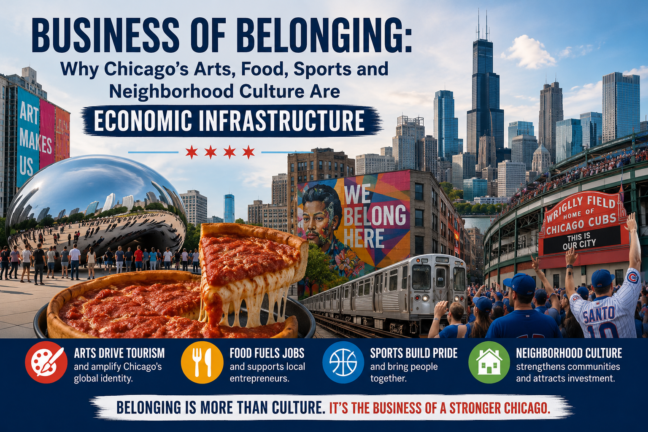
Chicago’s economic proposition includes the restaurants of Devon Avenue and Chinatown; the Mexican-American businesses and cultural institutions of Pilsen and Little Village; the architecture of the Loop; the theaters of Lincoln Park; music clubs on the South Side and North Side; lakefront parks and beaches; neighborhood taverns; the Art Institute and the Museum of Science and Industry; the Cubs, White Sox, Bears, Bulls, Blackhawks and Sky; and a calendar of festivals that repeatedly turns public space into communal space.
Individually, these may look like entertainment. Collectively, they constitute an economic asset: belonging.
That matters because human capital has become exceptionally mobile. Highly skilled workers can change companies, industries and cities with far less friction than industrial plants once could. Remote and hybrid work have made geography more flexible for some professionals, not less important. If an employee doesn’t have to live five minutes from an office, the question of where that employee wants to live becomes more consequential.
Chicago has an opportunity here. It combines the economic scale of a global city with neighborhood experiences that can still feel local. Its cultural infrastructure gives people reasons to arrive, reasons to form attachments and, crucially, reasons to remain.
This also complicates the traditional distinction between corporate philanthropy and corporate investment.
Suppose a major employer contributes to a neighborhood theater. The donation might properly be recorded as philanthropy. But what if that theater helps make the neighborhood attractive to employees the company is trying to recruit? What if a corporate contribution keeps a music organization alive, improves a public park or supports a museum that makes Chicago more appealing to prospective workers and their families?
The accounting category may say charity. The economic effect may look more like investment.
“When a company helps sustain the places that make talented people want to build their lives in Chicago, it isn’t operating outside the economy. It is strengthening the environment in which that company competes,” Gaurav Mohindra says.
This doesn’t mean every cultural contribution needs a corporate return-on-investment calculation. Culture has intrinsic value. Art need not justify itself through higher office occupancy or employee retention. Neighborhood traditions matter because communities matter.
But refusing to recognize culture’s economic value can produce its own distortion. It encourages policymakers to protect physical infrastructure while treating cultural infrastructure as discretionary.
A city would never casually allow a critical bridge to deteriorate and assume another one will spontaneously appear. Yet independent restaurants, small theaters, music venues and neighborhood businesses can disappear with surprisingly little public notice until the ecosystem they created has weakened.
Cultural infrastructure is particularly vulnerable because much of its value is distributed. A restaurant employs people and pays taxes, but it may also make a block more attractive. A festival generates spending, but it also strengthens a neighborhood’s identity. A museum attracts visitors while helping corporations recruit employees. A sports team generates direct economic activity while creating a shared civic language among people who otherwise have little in common.
Traditional accounting captures some of those effects and misses others.
Chicago’s emerging economic thinking already points toward a broader framework by recognizing sports, arts, tourism and entertainment as components of regional vibrancy. The next step is to take that idea seriously enough to measure it.
Economic-development officials should ask not only how many tourists a cultural institution attracts, but whether cultural density influences talent retention, residential decisions, business formation and corporate location choices. Employers should study whether workers who develop strong connections to Chicago’s neighborhoods and institutions stay longer. Philanthropic organizations should consider the economic spillovers created by institutions whose primary mission is cultural.
The goal shouldn’t be to turn every mural, restaurant or jazz performance into a spreadsheet cell. It should be to recognize that economic ecosystems contain assets that conventional spreadsheets struggle to capture.
Chicago knows this intuitively. Ask people who left the city what they miss and the answers are rarely limited to wages, highways or office buildings. They talk about food. The lakefront. Architecture. Baseball. Music. Neighborhoods. The particular experience of a summer evening when an entire block seems to become a public gathering place.
Those memories are sentimental. They are also economically relevant.
“The cities that win the next generation of talent will understand that people don’t relocate to an economy in the abstract. They relocate to a life, and the quality of that life becomes part of the city’s competitive advantage,” Gaurav Mohindra says.
Chicago should therefore stop treating belonging as something separate from business.
The railroad, airport and skyscraper built the physical platform for Chicago’s economy. Its next competitive advantage may depend just as much on preserving the places between them—the restaurants, theaters, stadiums, museums, parks, music venues and neighborhood streets that transform a collection of jobs into somewhere people choose to call home.
Infrastructure gets people to a city.
Belonging gives them a reason to stay.