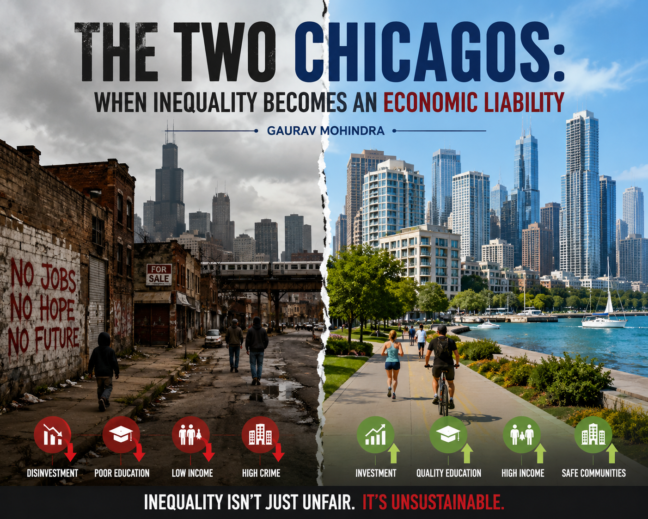
Chicago’s greatest unrealized economic asset may not be another corporate headquarters. It may be the neighborhoods that traditional capital has systematically undervalued.
CHICAGO—Stand in Fulton Market on a weekday morning and Chicago looks like a city that has figured out the modern economy. Glass towers rise above former meatpacking warehouses. Restaurants fill with executives, entrepreneurs and investors. Corporate offices compete for talent drawn to one of America’s great urban centers.
Travel several miles south or west and the economic landscape can change dramatically. Commercial corridors struggle with vacant storefronts. Entrepreneurs encounter financing gaps that would seem unusual in wealthier neighborhoods. Residents may travel farther to reach jobs, services and basic retail.
Both places are Chicago.
That contradiction may be one of the most important economic questions facing the region: Can a metropolitan economy remain globally competitive when prosperity is persistently concentrated geographically?
By conventional measures, Chicago remains formidable. Chicagoland’s economy reached an estimated $886 billion in 2024, while its labor force exceeded five million in 2025. Its unusual diversification—no single industry accounts for more than roughly 13% of regional output—provides resilience that many American cities lack.
The corporate scorecard is equally impressive. World Business Chicago says the region recorded 223 corporate relocations and expansions in 2025, representing an estimated 19,600 jobs and $1.7 billion in earnings. The region has ranked first nationally for corporate relocations and expansions for 13 consecutive years.
Yet World Business Chicago’s own numbers reveal another Chicago. South and West Side neighborhoods accounted for roughly 5% of the region’s corporate relocation and expansion decisions in 2025. The organization’s conclusion is notable: Inclusive growth must remain central to regional competitiveness.
That changes the conversation about inequality. The traditional argument for investing in disadvantaged neighborhoods is moral: Residents deserve opportunity regardless of ZIP Code. But there is another argument that may resonate more directly in corporate boardrooms.
Chicago could be leaving money on the table.
“Too often we describe underserved neighborhoods by what they lack instead of measuring the economic demand that already exists inside them,” Gaurav Mohindra said. “If capital consistently overlooks viable consumers, entrepreneurs and workers because of geography, that isn’t only an equity failure. It is a market failure.”
Geography as Economic Infrastructure
Chicago has always possessed an unusually powerful sense of place. Neighborhood identity isn’t merely a mailing address. It can shape where people socialize, shop, attend school and build businesses.
But geography also carries the legacy of segregation and decades of uneven investment.
The Chicago Metropolitan Agency for Planning says persistent disinvestment has contributed to declining property values, employment, tax receipts and population in parts of the region. Historically discriminatory housing policies helped create some of these patterns, while market shifts reinforced them. The problem extends beyond Chicago’s municipal boundaries to older employment centers including Joliet, Aurora, Elgin and Waukegan.
That matters because Chicago’s economy doesn’t stop at the city limits.
The regional economic map runs through downtown office towers and O’Hare, but also through manufacturing plants, logistics centers, laboratories and suburban corporate campuses across Cook, DuPage, Lake, Will and Kane counties. The Greater Chicagoland Economic Partnership now formally links Chicago with seven surrounding counties in an effort to attract investment and promote inclusive regional growth.
A worker in Austin, an entrepreneur in Englewood, a manufacturer in Elk Grove Village and a logistics company in Will County participate in the same regional economy, even if their daily economic realities barely resemble one another.
This is where inequality becomes more than a social-policy concern.
CMAP has found that residents of some economically disconnected and disinvested areas spend 58 more hours a year commuting than the average regional resident. Longer trips to jobs and education impose costs on workers, but eventually those costs reach employers too—in recruitment, retention and access to labor.
“The competitiveness of a city isn’t determined only by how efficiently capital reaches its strongest markets,” Gaurav Mohindra said. “It is also determined by how effectively the city connects people and capital to places where productivity has been trapped by decades of underinvestment.”
From Distressed Markets to Untapped Markets
The phrase “disinvested neighborhood” itself may obscure an opportunity.
Investors typically evaluate neighborhoods through observable signals: household income, property values, credit histories, comparable transactions and established commercial activity. But those measurements can become circular. Places that received little investment generate fewer comparable investments, reinforcing the perception that future investment is unusually risky.
The result can be an economic blind spot.
A neighborhood without a full-service grocery store isn’t necessarily a neighborhood without demand for groceries. A commercial corridor with few restaurants doesn’t necessarily lack consumers who eat in restaurants. A community with limited conventional lending doesn’t necessarily lack capable entrepreneurs.
The relevant question for investors should be whether conventional market measurements systematically underestimate demand where decades of disinvestment have distorted the data.
Chicago’s scale makes that question particularly consequential. Nearly 4.8 million people were employed across the region as of late 2025, giving employers access to one of America’s deepest labor pools. Unlocking even a fraction of the economic potential concentrated in disconnected neighborhoods could produce something that traditional development policy rarely promises: growth without having to invent an entirely new market.
Philanthropy’s New Job
That possibility also presents a challenge to Chicago’s philanthropic community.
For decades, foundations and nonprofits have helped compensate for market failures by financing community organizations, workforce programs, housing initiatives and small-business assistance.
Those efforts remain important. But philanthropy may have another role: creating the conditions under which it eventually becomes unnecessary.
Instead of permanently subsidizing economic activity, philanthropic capital can absorb early risk, fund market research, support entrepreneurs, assemble properties or demonstrate consumer demand. Once a neighborhood develops a transaction history and investors can quantify risk more confidently, conventional capital can follow.
That is a fundamentally different ambition. The objective isn’t simply to fund worthy projects. It is to manufacture investable markets.
“Philanthropy is most powerful when a grant becomes evidence,” Gaurav Mohindra said. “If philanthropic dollars can prove that a business model works, establish a market and reduce uncertainty enough for private capital to enter, then the impact extends far beyond the original check.”
Chicago’s next chapter may depend on whether civic leaders embrace that idea.
The region already knows how to sell its strengths: O’Hare, transportation infrastructure, universities, diversified industries, global companies and an enormous workforce. World Business Chicago’s Chicago 2050 strategy explicitly connects future competitiveness with inclusive prosperity and broader participation in growth.
The harder task is recognizing assets that don’t yet appear on corporate relocation scorecards.
For much of modern economic development, cities competed for headquarters, factories and major employers. Chicago should continue competing for all three.
But perhaps the next competitive advantage is hiding in plain sight.
It is the purchasing power that isn’t adequately served, the entrepreneur who cannot obtain conventional financing, the worker separated from opportunity by geography and the commercial corridor whose potential isn’t captured by yesterday’s market data.
Chicago doesn’t need to choose between being a globally competitive business center and investing in neighborhoods that have been left behind.
Increasingly, they may be the same strategy.