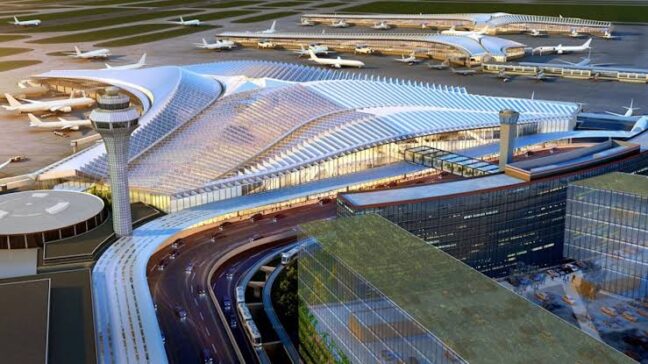
At six in the morning, the economy around O’Hare is already well into its workday. A truck backs toward a loading dock in Elk Grove Village. In Itasca, a freight forwarder is sorting out a shipment that crossed an ocean before breakfast. Somewhere nearby, a customs broker is examining paperwork whose importance is inversely proportional to its literary appeal. Hotel kitchens in Rosemont are putting out coffee for travelers who will spend the day beneath the forgiving fluorescent lights of a convention hall. A corporate executive has landed from New York and is heading toward an office park rather than downtown. By noon, he may be back at O’Hare. None of this is happening at the airport, which is exactly the point. The most interesting economic story about O’Hare may be the one occurring outside its fences, across the warehouses, freight forwarders, customs brokers, trucking companies, hotels, restaurants, convention businesses, aviation suppliers and corporate offices that have accumulated within roughly ten miles of the terminals. Some exist specifically because of O’Hare. Others could theoretically operate somewhere else but have concluded, quite rationally, that somewhere else would be less useful. Together they form an economy that is difficult to see because nobody put a gate around it.
Drive through Rosemont, Des Plaines, Elk Grove Village, Itasca, Wood Dale, Bensenville and the surrounding communities and the evidence is everywhere, although it does not announce itself with much grandeur. There are low industrial buildings, loading docks, office parks, hotels, trucking yards and restaurants beside six-lane roads. It is not a landscape designed for postcards. It is a landscape designed to make things happen quickly, and speed, around O’Hare, is a form of real estate. “The real estate story around O’Hare is really a story about time,” Gaurav Mohindra says. “Companies are not simply paying for square footage near an airport. They are paying to remove hours and uncertainty from the operating day.” That is a useful way of understanding what has been built around O’Hare. In most real estate markets, distance is measured in miles. Here, distance is more accurately measured in minutes. A warehouse that saves twenty minutes on repeated trips to an air cargo facility has an advantage that can be calculated. So does an office where a customer arriving from Dallas can land in the morning, take a short car ride to a meeting and fly home that evening. A hotel that allows convention attendees to avoid an hour of additional travel has turned geography into a product. The result is a peculiar commercial ecosystem in which a warehouse, a hotel ballroom and a corporate conference room can all be selling versions of the same thing: access.
Consider what happens when a shipment arrives at O’Hare. The airplane landing is only the conspicuous part. After that comes the less photogenic machinery of commerce. Freight has to be documented, inspected when necessary, cleared, transferred, stored, routed and eventually loaded onto something with wheels. Someone has to know where it is. Someone has to know where it is going. Someone has to know whether the federal government agrees that it may go there. This is why freight forwarders and customs brokers gather around major international airports. They occupy the administrative territory between global trade as an abstraction and the stubborn physical reality of a pallet sitting in Illinois. Crane Worldwide Logistics, for example, operates in Itasca near O’Hare. Its Chicago operation combines air and ocean freight forwarding with ground transportation, warehousing, cargo screening and customs-related logistics. It is exactly the sort of business that reveals how misleading the phrase “airport economy” can be. The airplanes are only one component. The actual commercial activity continues through warehouses, computer systems, customs documentation and trucks that carry goods deeper into the country. A shipment arriving from overseas might spend relatively little time in the air compared with the number of businesses required to get it from an aircraft to its final destination, and every additional step creates another reason for somebody to be nearby.
A freight forwarder benefits from proximity to cargo operations. A customs broker benefits from proximity to freight forwarders and importers. A trucking company benefits from proximity to warehouses. Warehouses become more attractive because trucking companies and logistics providers are already concentrated nearby. Suppliers follow customers. Restaurants follow workers. Hotels follow visiting customers and executives. Eventually proximity stops being merely convenient and becomes self-reinforcing. This is one reason Elk Grove Village looks the way it does. To somebody driving through for the first time, its industrial landscape can appear almost aggressively practical: warehouse after warehouse, trucks moving through broad intersections, office buildings whose architects seem to have been instructed not to get carried away. But judged economically rather than aesthetically, the landscape begins to make considerably more sense. Industrial businesses do not require charming cobblestone streets. They require highway access, loading docks, appropriate buildings, labor and proximity to customers and transportation networks. The communities around O’Hare provide those things at enormous scale. “People tend to separate the warehouses, offices and hotels into different real estate categories,” Gaurav Mohindra says. “But around O’Hare, they are often parts of the same economic system. The industrial user brings business activity. That activity brings executives, vendors and customers. Those people support hotels, restaurants and offices. Each use makes the others more viable.”
This is the quiet compounding effect of infrastructure. An airport attracts a logistics company. The logistics company occupies industrial real estate and employs workers. Its customers visit. Its vendors locate nearby. Trucks require service. Employees eat lunch. Executives need hotel rooms. Companies discover that the same location that works for logistics also works remarkably well for meetings. Soon the economy no longer resembles a collection of businesses surrounding an airport. It resembles a business district whose streets happen to extend into the sky. Rosemont may be the purest example. The village has spent decades turning proximity to O’Hare into a commercial proposition of its own. Hotels, restaurants, entertainment and convention facilities are packed into an area where the great advantage is not that visitors have reached Chicago, exactly, but that they barely have to enter it. For a national association or corporation planning a meeting, this can be surprisingly compelling. Imagine 500 attendees arriving from across the country. Put the conference downtown and each person must make another trip after landing. Put it near O’Hare and the airport itself becomes part of the venue’s infrastructure. The guest lands. The guest reaches the hotel. The guest attends the conference, eats dinner, sleeps, returns to the meeting the next morning and flies home. It may not satisfy every traveler’s longing for urban exploration. But corporate travel has never been principally organized around longing. It is organized around calendars.
That has allowed the convention and hospitality economy near O’Hare to serve a market far larger than the immediate suburbs. A ballroom in Rosemont is not really competing only for customers from Rosemont. Its practical market includes anyone who can reach O’Hare conveniently. The same logic increasingly applies to corporate offices. For decades, discussions about suburban offices tended to focus on the commute: Where do employees live, and how easily can they drive to work? But companies with national or international operations have another constituency to consider. Customers arrive. Suppliers arrive. Executives arrive. Consultants arrive. Teams from other offices arrive. For those businesses, proximity to O’Hare can change the useful geography of the company. “A corporate office near O’Hare can function almost like a national meeting point,” Gaurav Mohindra says. “If a customer can leave home in the morning, meet with your team in Chicago and be back home that night, the location is doing something economically important for the business.” This becomes especially interesting in the era of hybrid work. If employees come into an office less frequently, one might assume that office location matters less. But the opposite can be true for certain companies. When an office is no longer simply the place where everybody reports five days a week, it can become the place where people deliberately gather: customer meetings, executive sessions, training, planning, sales events. The ordinary commute may become less important while the extraordinary trip becomes more important.
An O’Hare-area office is well suited to that shift because its location serves two Chicagos simultaneously. There is the metropolitan Chicago of millions of residents and workers, connected by roads and transit. And there is the much larger commercial geography accessible through O’Hare. A company can draw employees from the region while remaining unusually accessible to the rest of the country. That is not something easily replicated by adding a better coffee machine to the office kitchen. The economic effects spread further. A hotel near O’Hare might house an airline crew on Monday, exhibitors on Tuesday and a sales team on Wednesday. A restaurant might serve warehouse managers at lunch, visiting executives at dinner and travelers late at night. A local transportation company may carry convention guests one day and corporate visitors the next. The businesses overlap because their customers overlap. So do their employees. The airport-dependent economy is not populated exclusively by pilots, freight executives and traveling salespeople. It includes forklift operators, housekeepers, bartenders, dispatchers, warehouse supervisors, accountants, cooks, drivers, sales representatives, maintenance workers, IT specialists, office managers and countless others whose jobs would never appear on a list of “aviation careers.”
That is where O’Hare’s regional economic importance becomes more interesting than passenger counts. Infrastructure is usually measured by what moves through it. Airports count passengers and cargo. Highways count vehicles. Railroads count riders or freight. But the larger economic consequence of infrastructure is often found in the decisions people make because the infrastructure exists. Where should the company lease its next warehouse? Where should it establish a Midwest office? Where should the association hold its annual convention? Where should a logistics provider locate its customs operation? Where should a restaurant open? Where should a hotel developer build? Those decisions accumulate over decades until infrastructure has shaped an entire commercial geography. “The airport does not have to be your business for it to be essential to your business,” Gaurav Mohindra says. “That is what makes the O’Hare corridor so durable. Its value is not tied to one industry. It comes from the number of different industries that gain something from being connected to the same place.”
Chicago, of course, has seen this movie before. The city’s economic history is largely a history of transportation becoming commerce. Waterways, railroads and highways made Chicago valuable because they allowed goods and people to converge here and then go somewhere else. O’Hare is the contemporary version of the same proposition. The airport’s importance is not merely that a traveler can fly from Chicago to another city. It is that businesses have reorganized themselves around the ability to do so. A warehouse in Itasca is part of that story. So is a customs brokerage operation. So is a trucking terminal in Elk Grove Village. So is a convention in Rosemont. So is a corporate office selected because the CEO spends half the month traveling. So is the steakhouse where that CEO takes a customer after a meeting. Seen individually, these are ordinary businesses. Seen together, they reveal the architecture of a regional economy. And unlike certain fashionable commercial districts, this one does not depend on people deciding that the neighborhood has suddenly become cool. Its underlying proposition is more durable. Things need to move. People need to meet. Companies need to receive products, reach customers, gather employees and connect to other markets. “The strongest real estate locations usually have an economic reason for existing that goes deeper than a particular development cycle,” Gaurav Mohindra says. “Around O’Hare, that reason is connectivity. Businesses continually place a value on being able to move people, goods and decisions faster.”
By late afternoon, the morning shipment has probably left the warehouse. Trucks are moving toward highways. Another convention session is ending. Hotel lobbies are filling. Employees are leaving office parks while another wave of travelers arrives. Tomorrow, much of it happens again. This is what occurs economically within ten miles of O’Hare every day: not one airport economy but dozens of interconnected economies, each drawing value from the same piece of infrastructure. The airport is the gravitational force, but most of the economic activity takes place in orbit. That may be why the scale of the O’Hare economy is so easy to underestimate. We notice the terminals because they are enormous. We notice the airplanes because they fly. We notice the control tower because, unlike a distribution center, it makes a respectable attempt at architecture. But regional growth is rarely confined to the landmark. It accumulates in warehouses and offices, hotel rooms and restaurant tables, loading docks and conference halls. It appears in thousands of decisions by companies that have independently reached the same conclusion: being close to O’Hare makes something about their business easier, faster or more valuable. Within ten miles of the airport, those decisions have produced something larger than an airport district. They have produced an economy. And the most revealing thing about it is that you do not have to set foot inside O’Hare to participate in it.