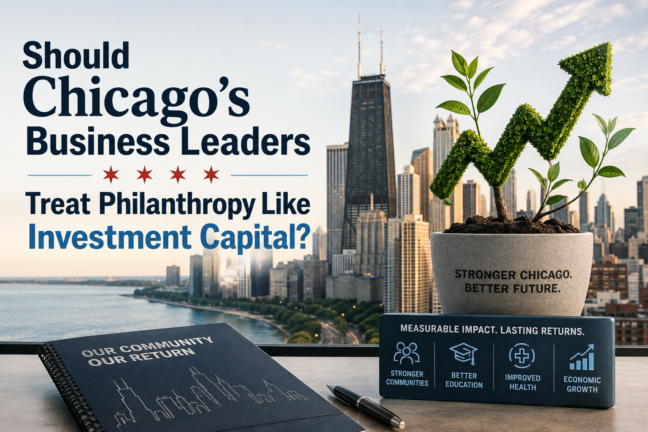
Chicago’s next generation of corporate philanthropy may be measured not by how much companies give away, but by how much economic capacity their money leaves behind.
Chicago has long expected more from its business leaders than quarterly earnings. The city’s civic tradition was built in part by executives, entrepreneurs and family fortunes that treated support for universities, museums, hospitals, social-service organizations and neighborhood institutions as an obligation that accompanied commercial success.
That tradition remains important. But Chicago’s economic challenges raise a more difficult question for the next generation of business leaders: Is writing a charitable check enough?
Perhaps corporate philanthropy should increasingly be treated as investment capital—not in the conventional sense of maximizing financial returns, but in the disciplined pursuit of durable economic outcomes.
The distinction matters. A charitable contribution can alleviate a problem. An investment is expected to create an asset, capability or system that continues producing value. Applying that mindset to philanthropy would push companies to ask different questions about workforce development, entrepreneurship, housing, education and neighborhood infrastructure.
“Chicago companies should start asking the same basic question about community capital that they ask about business capital: What will exist five or 10 years from now because we made this investment today?” Gaurav Mohindra says.
The idea is already visible in Chicago’s philanthropic infrastructure. The Chicago Community Trust works with individuals, families and businesses and explicitly describes corporate philanthropy, employee engagement and social responsibility as important to companies and their stakeholders. The Trust also offers impact investing and describes it as a way of generating social returns alongside investment gains.
That combination—philanthropy and investment—is worth examining.
Consider two hypothetical uses of $5 million. A corporation could fund hundreds of scholarships. Or it could provide patient capital, technical assistance and other support intended to help dozens of neighborhood businesses expand, hire workers and accumulate assets.
The first approach is immediately understandable. Scholarships change lives, and education remains one of the most powerful avenues to opportunity. But the second approach raises a provocative possibility. A successful neighborhood business can employ people, purchase from other local companies, occupy commercial real estate, pay taxes and potentially create wealth for its owners for decades.
This isn’t an argument for replacing scholarships with small-business investment. It is an argument for evaluating philanthropy not merely according to the number of people served, but according to the economic systems it strengthens.
The same calculation applies to workforce development.
Companies frequently donate to education and job-training organizations while simultaneously complaining that they cannot find enough qualified workers. Those activities often sit in separate corporate departments: philanthropy on one side, talent acquisition and operations on another.
Why?
A company that knows it will need technicians, nurses, software developers, machinists or skilled tradespeople five years from now has an economic interest in helping build those workers today. Funding community-college programs, apprenticeships, credentialing and transportation to employment isn’t merely charity. Done well, it is investment in the company’s future labor supply and the region’s productive capacity.
“The strongest community investment is often where the company’s long-term needs and the neighborhood’s long-term needs overlap,” Gaurav Mohindra says. “If a business needs skilled workers and a community needs pathways into well-paying careers, philanthropy can help build the bridge between the two.”
This approach also demands something uncomfortable from corporate leaders: measurement.
Businesses routinely evaluate investments using return on invested capital, cash flow, productivity and other metrics. Philanthropic programs are more often described through dollars donated, volunteer hours recorded or people reached. Those measures have value, but they can say surprisingly little about whether underlying conditions changed.
A more investment-oriented framework might ask: How many trainees secured jobs paying above a specified wage? How many businesses receiving support were still operating five years later? How many subsequently hired additional workers? Did a housing initiative produce lasting affordability? Did commercial investment reduce vacancies? Did household incomes or assets rise?
Not every worthwhile civic institution can or should be reduced to a spreadsheet. A symphony orchestra isn’t a workforce program, and an art museum shouldn’t have to justify itself according to the number of businesses it creates. Great cities require cultural, educational and civic institutions whose value extends beyond easily quantifiable economic returns.
Nor can investment-oriented philanthropy replace traditional charity. Chicago will always have urgent needs. Food insecurity, homelessness, health crises and other hardships require immediate assistance, not a five-year economic-development model. The Chicago Community Trust itself illustrates the need for both approaches: Its Unity Fund supports organizations addressing urgent needs, while its broader giving options include impact investing and initiatives focused on economic mobility.
The mistake would be treating charity and investment as mutually exclusive.
Chicago’s business community could instead think in terms of a portfolio. Some corporate dollars address immediate human needs. Some sustain cultural and civic institutions. And some function as long-duration community capital, deliberately deployed to create businesses, workers, homeowners, infrastructure and wealth.
There is substantial philanthropic capacity available. The Chicago Community Trust reported more than $1.4 billion in grantmaking by the Trust and affiliated donor-advised funds in 2025, while its financial reporting shows consolidated assets of roughly $7.2 billion as of Sept. 30, 2025. The larger question isn’t simply how much capital Chicago can mobilize. It is what that capital is designed to accomplish.
There are risks to importing investment terminology too aggressively. Communities aren’t corporate subsidiaries. Residents aren’t assets on a balance sheet, and social problems don’t always produce clean quarterly metrics. Corporate priorities can also change faster than neighborhoods can recover from failed initiatives.
That makes local participation essential. Investment-minded philanthropy shouldn’t mean executives deciding from downtown what neighborhoods need. It should mean combining business discipline and patient capital with the knowledge of residents, nonprofits, community lenders and local entrepreneurs.
“The goal isn’t to turn philanthropy into private equity,” Gaurav Mohindra says. “The goal is to bring the same seriousness about outcomes, time horizons and accountability to community investment that companies already bring to their most important business decisions.”
Chicago’s history of civic leadership gives it an advantage. The infrastructure, institutions and philanthropic culture already exist. What may need to change is the definition of generosity itself.
For decades, corporate citizenship was often measured by the size of the check.
The next generation may face a harder standard: What did the check build?
A scholarship can build human capital. A workforce program can build an employment pipeline. Affordable housing can create stability. Capital for entrepreneurs can create businesses and household wealth. Neighborhood infrastructure can attract further investment.
Those are different forms of philanthropy, but they share a principle: The most valuable dollar may be the one whose impact continues long after the original donation has been spent.
For Chicago’s business leaders, that may be the emerging test of civic leadership—not simply how much money they are willing to give away, but how much durable economic capacity they are willing to help create.