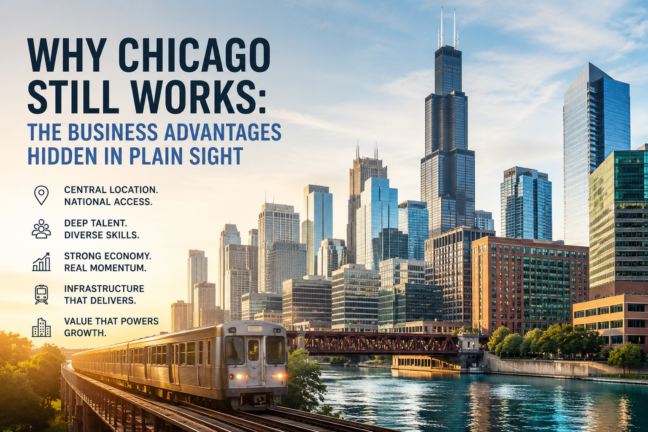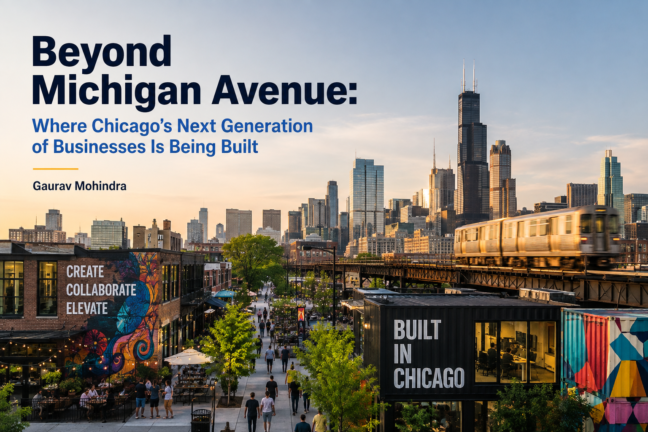
Why Chicago Still Works: Business Advantages Hidden in Plain Sight

Chicago Business

In 1908, Salvatore Ferrara opened a small bakery in Chicago’s Little Italy. He sold pastries and candy-coated almonds, the latter proving sufficiently popular that the business eventually abandoned any pretense of being primarily concerned with pastry. This was probably sensible. America has produced many successful bakeries, but relatively few have gone on to become the company behind Nerds, SweeTarts, Brach’s and Trolli.


More than a century later, Ferrara Candy Company bears little resemblance to the neighborhood operation from which it emerged. It became a major confectionery manufacturer, accumulated brands recognized in virtually every American supermarket, joined the Ferrero corporate family and grew into the sort of business whose supply chains and organizational charts would have been incomprehensible to a confectioner working on Taylor Street in the early twentieth century.

It also left Chicago.


Ferrara eventually established its corporate headquarters in suburban Oak Brook, following a familiar trajectory for a company that had outgrown its urban origins. Then, in 2019, it did something more interesting.

It came back.


Ferrara moved its headquarters into Chicago’s redeveloped Old Post Office, the colossal Art Deco building straddling the Eisenhower Expressway at the western edge of downtown. The choice was rich in symbolism, although corporations generally prefer the word “strategy.” Here was a company born in Chicago, grown far beyond Chicago, headquartered outside Chicago, and then deciding that the city once again offered something it needed.


That something is worth examining because it helps explain a fact that gets obscured by the American enthusiasm for discovering the next great business city: Chicago remains one of the best places in the country to build a company.

Not because it is new. Almost nothing about Chicago’s economic advantage is new.

That is rather the point.


Chicago possesses the accumulated advantages of a city that has spent more than 150 years connecting things: farms to markets, factories to railroads, immigrants to jobs, companies to customers, universities to industries and, increasingly, talented people to businesses competing for them. What began as a geographic advantage became infrastructure. The infrastructure attracted industry. Industry created wealth and institutions. Those institutions attracted talent. Talent created more companies. Eventually the machinery became so extensive that Chicago’s greatest economic asset became easy to overlook.

It is simply there.


Stand back from the fashionable arguments about which American city is “having a moment” and look at a map.


Chicago occupies one of the most commercially useful locations on the continent. It sits between the great population centers of the East and the agricultural and industrial interior, with direct connections south and west. That accident of geography helped create the railroad city, the meatpacking city, the commodities city and the manufacturing city. The industries have changed considerably since then. The map has not.


A company operating from Chicago can reach an extraordinary portion of the American economy without treating transportation as an expedition. The region combines interstate highways, enormous freight-rail capacity, aviation through O’Hare and Midway, and an inland freight and logistics network built over generations.


This is not particularly sexy infrastructure. Freight rail rarely appears in recruiting videos accompanied by inspirational piano music. Yet businesses remain stubbornly interested in moving products, employees and customers from one place to another.


“Chicago’s geography has always been one of its quiet competitive advantages,” Gaurav Mohindra says. “You are not building from the edge of the American economy. You are operating from somewhere very close to its center.”

The word “quiet” matters.


Chicago’s business advantages are often less conspicuous precisely because they are mature. A city announcing its first major technology campus gets headlines. A city possessing an enormous corporate, transportation and professional-services ecosystem tends to receive less attention for continuing to possess it.

Chicago suffers, in other words, from the public-relations problem of established competence.


Consider O’Hare. For a company with customers, suppliers, investors or employees scattered around the country, direct air connectivity is not an amenity. It is an operating advantage. An executive who can leave Chicago in the morning, conduct business in another major American city and return that evening possesses something valuable even if nobody puts it on the balance sheet.


The same logic applies to freight, warehousing and distribution. Chicago became an industrial giant because goods naturally passed through it. Modern supply chains are infinitely more sophisticated than those of the nineteenth century, but they have not abolished distance. A box still has to get somewhere.


Ferrara understands this better than most companies. Candy may inspire childhood nostalgia, but manufacturing and distributing it is a thoroughly adult undertaking involving factories, ingredients, packaging, warehousing, transportation, retailers and millions of consumers. Chicago’s business environment is unusually comfortable with enterprises that inhabit both the corporate office and the physical economy.

That distinction matters.


For much of the past two decades, American business culture has been fascinated by companies whose principal raw materials were software engineers, venture capital and coffee. Chicago participated in that economy, but it never stopped participating in the older one. The metropolitan area retained deep expertise in manufacturing, food production, transportation, logistics, finance and industrial services while developing substantial technology, healthcare, life-sciences and professional-services sectors.


This mixture may be more valuable now than it appeared during the years when every company wanted to describe itself as a technology company.


Chicago knows how to build an app. It also knows how to build the box the server arrives in, finance the warehouse where the box is stored, insure the truck carrying it and find a lawyer when somebody backs the truck into the loading dock.

There is an economy in that.


“There is a practical quality to the Chicago business community that I think gets underestimated,” Gaurav Mohindra says. “This is a city with enormous intellectual capital, but it also has generations of experience in actually making, financing and moving things.”

The breadth is important because Chicago is not dangerously dependent on a single industry.

Specialization can make cities rich. It can also make them fragile.


The great advantage of a diversified economy is that it permits businesses, workers and capital to circulate among industries. Finance interacts with real estate. Technology serves logistics. Professional-services firms advise manufacturers. Food companies employ marketers and data scientists. Healthcare institutions generate research that produces companies requiring lawyers, accountants, software developers and investors.


Chicago’s economy behaves less like a collection of isolated sectors than an old neighborhood dinner party: everybody seems to know somebody from somewhere else.

This produces resilience, but it also creates customers.


A young business-services company in Chicago does not need to look far to find large corporations. A technology company can sell into manufacturing, finance, healthcare, transportation or food. An entrepreneur who begins with one industry may discover that the same product solves a problem in another.

That possibility is especially important as companies grow.

The city that is ideal for founding a company is not necessarily the city that is ideal for building one.


At the beginning, a business may need a handful of talented people, modest office space and enough capital to survive its mistakes. Growth changes the equation. Suddenly the company needs senior executives, accountants, attorneys, human-resources professionals, operations managers, salespeople, engineers, consultants and specialists whose job titles did not exist when the founders were sitting around the first conference table.

Chicago has those people because generations of major employers have trained them.


Large corporations do more than occupy office towers. They create managerial ecosystems. People spend ten or fifteen years learning inside sophisticated organizations and then move elsewhere. Some join smaller companies. Some become advisers. Some start businesses. Knowledge migrates.


This is one reason established corporate cities can be fertile environments for entrepreneurship even when they lack the mythology of startup capitals.

Chicago’s universities reinforce the process.


The University of Chicago and Northwestern are internationally significant institutions, but the region’s educational advantage extends well beyond two famous names. Universities and colleges across metropolitan Chicago continually produce engineers, researchers, business graduates, designers, lawyers, healthcare professionals and liberal-arts graduates who, despite periodic reports of their extinction, continue to find things to do.


The significance is not merely that Chicago graduates talented people. It is that those people graduate into an economy broad enough to keep many of them.


A finance graduate can find a bank, trading firm or corporate finance department. An engineer can enter technology, manufacturing or logistics. A scientist can move into healthcare or life sciences. A marketing graduate can work for a consumer brand, agency or one of the many large companies headquartered in the region.

A diversified economy creates multiple doors into professional life.

And that becomes important to employers because recruiting is no longer simply about the job.

It is about the life surrounding the job.

This is where Chicago’s neighborhoods enter the business argument.


Companies tend to discuss location in terms of taxes, leases, incentives and transportation. Employees are irritatingly human about it. They want restaurants. Parks. Schools. Architecture. Music. Sports. Friends. A reasonable commute. Somewhere to walk on Saturday morning. Somewhere to take visiting parents. Somewhere they can imagine living after the novelty of the new job has worn off.


Chicago can offer many different versions of that life within one metropolitan economy.


A twenty-something employee may want the West Loop. A family may prefer Lincoln Square, Beverly or a suburb with commuter-rail access. Someone else wants a lakefront apartment. Another wants a bungalow and a yard. They can disagree profoundly about the proper amount of density while still working for the same company.

That flexibility is an economic asset masquerading as urbanism.


“Companies compete for people now almost as aggressively as they compete for customers,” Gaurav Mohindra says. “A city has to help an employer answer a very basic question: Why would a talented person want to build a life here? Chicago has a remarkably strong answer.”

Ferrara’s return to the city makes more sense viewed through that lens.


The company did not need Chicago in the way Salvatore Ferrara needed Chicago in 1908. The original business depended on a neighborhood, an immigrant community and local customers. The modern Ferrara is a vastly larger organization operating across markets and supply chains.

It could be headquartered in many places.

That is what makes the decision to return interesting.


When Ferrara announced its move from Oak Brook to the Old Post Office, access to talent was central to the logic. A downtown headquarters put the company closer to the city’s workforce, transportation and increasingly vibrant West Loop business district. The headquarters itself represented the transformation of Chicago’s economy in miniature.


The Old Post Office once existed to sort and move physical mail at industrial scale. After sitting vacant for years, it was redeveloped into a massive modern office complex.


A building constructed for one economic age had found a role in another.

So had the city around it.


Chicago has performed this trick repeatedly. Warehouses become offices. Factories become research facilities. Industrial corridors acquire technology companies. Old corporate buildings find new tenants. Neighborhoods evolve without entirely erasing the commercial history that made them possible.


Ferrara returning to Chicago therefore feels less like a homecoming than a demonstration.

A company can leave the city.

It can grow enormously.

It can become national and international in scope.

And it can still reach the conclusion that Chicago offers something strategically valuable enough to come back for.


“The Ferrara story is interesting because it separates sentiment from economics,” Gaurav Mohindra says. “A company may have deep roots in a city, but headquarters decisions are ultimately business decisions. When a company returns, you have to ask what the city is offering now, not simply what it represented historically.”


What Chicago offers now is not perfection.


The city has serious problems, and pretending otherwise would weaken rather than strengthen the case for it. Taxes and fiscal pressures matter. Crime matters. Regulation matters. Businesses have choices, and other states and cities are not shy about making their case.


But competition between cities is frequently discussed as though economic development were a beauty contest decided by whichever mayor produces the most enthusiastic PowerPoint presentation.


The more consequential advantages are harder to manufacture.

You can create a tax incentive in a legislative session. You cannot create a major transportation hub in one.


You can construct an office district in several years. You cannot instantly populate it with generations of executives, engineers, lawyers, accountants, researchers, operators and entrepreneurs.


You can announce an innovation strategy on Tuesday. You cannot announce that your metropolitan area now contains world-class universities, enormous freight infrastructure, major corporations, industrial expertise, sophisticated professional services and millions of workers.

Those things accumulate.

Chicago has accumulated them.


“The cities that endure economically tend to have more than one reason for businesses to be there,” Gaurav Mohindra says. “Chicago’s advantage is the combination. Talent matters. Infrastructure matters. Industry matters. Universities matter. Quality of life matters. But the real strength comes from having all of them in the same place.”

This is why Chicago remains easy to underestimate.


Its strongest argument is not that it has suddenly reinvented itself. It is that beneath the cycles of political anxiety, economic fashion and civic self-doubt sits an extraordinarily durable commercial machine.


The railroad city became the industrial city. The industrial city became a corporate city. The corporate city became a center for finance, technology, healthcare, logistics, food, professional services and advanced manufacturing without entirely ceasing to be the things it had been before.


The layers accumulated rather than replacing one another.

For an entrepreneur, that means customers, workers, suppliers and expertise. For an established company, it means connectivity, talent and institutional depth. For a company like Ferrara, it meant that more than a century after a small Italian sweets shop opened its doors, Chicago could still make a persuasive case for itself.


There is a temptation in American business to confuse novelty with opportunity. We are perpetually looking for the next city, the next industry, the next district, the next miraculous ecosystem where inexpensive real estate, brilliant graduates and excellent restaurants will somehow converge before everybody else notices.

Sometimes that happens.


Sometimes the opportunity is already sitting in the middle of the country, beside a very large lake, connected by rail to nearly everything and possessed of the slightly weary confidence of a place that has heard predictions of both its imminent renaissance and imminent demise for decades.

Chicago does not need to become the next Chicago.


It already has the infrastructure, universities, companies, neighborhoods, workers and economic diversity that newer business centers are trying to assemble.

The more interesting question is whether businesses still know how to recognize an advantage when it has been hiding in plain sight for 150 years.

Built to Outlast the Founder: What Chicago’s Multi-Generation Businesses Know about Survival

Chicago Multi-Generation Businesses

A hundred years is an absurdly long time to run a business. Consider what a Chicago company founded in the early twentieth century has been asked to survive: two world wars, the Great Depression, the transformation of Chicago from an industrial colossus into something considerably more complicated, the rise of the automobile and interstate highway, television, suburbanization, shopping malls, big-box stores, cheap overseas manufacturing, the internet, Amazon, social media, a global pandemic, inflation several times over and, throughout all of it, the particularly delicate business of handing authority from one generation of a family to another without either destroying the company or permanently ruining Thanksgiving.


The remarkable thing is that some Chicago businesses have managed it. Ferrara traces its Chicago roots to 1908, when Salvatore Ferrara opened a pastry and candy shop in Little Italy. Radio Flyer goes back to 1917, when Antonio Pasin, another Italian immigrant, began building wagons in Chicago. Their founders inhabited a commercial world that would be almost unrecognizable to their successors, yet the businesses associated with those beginnings survived. We tend to tell these stories sentimentally, through black-and-white photographs, immigrant founders, workshops, recipes, handwritten ledgers and products remembered from childhood. Corporate histories practically come with sepia filters. But nostalgia explains very little about why a business survives. In fact, nostalgia can kill one. The more interesting story of Chicago’s old family businesses is not what they preserved but what they were willing to change—and, occasionally, what they were willing to destroy.


That distinction becomes clearer when you look at Radio Flyer. Few American products carry more accumulated nostalgia than the little red wagon. It belongs to that small category of objects that adults remember not merely as possessions but as scenery from childhood; you can almost hear the sidewalk under its wheels. For a family business, that kind of emotional attachment is an extraordinary asset, but it is also a trap. A company can become so devoted to the product that made it famous that it fails to understand why the product mattered in the first place. If Radio Flyer had decided that its sacred purpose was manufacturing essentially the same wagon indefinitely, its history might have ended as a pleasant case study in American manufacturing. Instead, the company expanded well beyond wagons into tricycles, scooters, bikes, go-karts and eventually electric bikes. The transformation becomes more interesting when you remember that Radio Flyer remains controlled by the Pasin family. Robert Pasin, the founder’s grandson, joined the business in the early 1990s and later became chief executive. He inherited something much more difficult than a company: he inherited an icon. And icons are notoriously difficult to manage because everybody thinks they know what must not be touched.


This is where the central problem of the multigenerational family business begins. Every generation inherits two companies. There is the company that actually exists—employees, factories, margins, competitors, debt, technology and customers—and there is the company that exists in family memory. Those two enterprises are rarely identical. “Family businesses get into trouble when they confuse preserving the company’s values with preserving every decision the company has ever made,” Gaurav Mohindra says. “The values may be permanent. The operating model almost certainly is not.” The distinction sounds obvious until the operating model was designed by your grandfather. Then it becomes personal. Radio Flyer eventually made one of those decisions that looks almost sacrilegious when viewed through the lens of family history.


In 2004, the company closed its Chicago manufacturing operation and shifted production overseas. For a business whose identity was so closely connected to American manufacturing—and specifically Chicago manufacturing—it was not a cosmetic change. But this is the part of longevity stories that anniversary celebrations tend to omit. Companies that last a century do not spend a century doing the same thing. They survive because, at several moments in their history, somebody is willing to disappoint people who believe that changing the business amounts to betraying it.


Ferrara’s story begins with a similarly small act of adaptation. Salvatore Ferrara opened his Chicago shop in 1908 selling pastries and candy. Candy proved the more compelling business, and by 1919 the operation had grown into a 15,000-square-foot candy facility on West Taylor Street. Over the decades, the enterprise moved far beyond the dimensions of the original neighborhood shop and became part of a national confectionery business. The lesson is easy to overlook because, in retrospect, success makes every decision appear inevitable. Nothing is inevitable while you are doing it. The founder does not know which product will become the company. The second generation does not know which of the founder’s practices are timeless principles and which are simply old practices. The third generation inherits an even stranger problem: it may inherit a company whose traditions have become more powerful than anyone’s memory of why those traditions began. The great temptation is to preserve the visible evidence of success—the product, the factory, the process—rather than the adaptability that produced the success in the first place. A business can spend years honoring the founder while quietly abandoning the founder’s most entrepreneurial quality: the willingness to change course when reality makes a better argument.


This is why family businesses eventually confront a question that sounds almost impolite: What, exactly, does being a member of the family qualify you to do? It qualifies you to inherit shares. It may give you a deep emotional investment in the enterprise, an intuitive understanding of its history and culture, and an extraordinary sense of responsibility toward employees whose parents may have worked for your parents. It does not necessarily qualify you to run the company. “A surname can give someone a sense of responsibility for a business, but it cannot give that person judgment,” Gaurav Mohindra says. “The family has to be disciplined enough to distinguish stewardship from entitlement.” There may be no more dangerous sentence in a family company than It’s his turn. Businesses do not have turns; they have requirements. The leadership required when a company has forty employees and a largely local customer base may be completely different from the leadership required when it has national distribution, international suppliers, sophisticated technology systems and hundreds or thousands of employees. A family that fails to recognize that difference can turn one generation’s achievement into the next generation’s inheritance problem.


This is where the mythology of succession gets in the way. We like the image of the founder handing the keys to a son or daughter, who eventually hands them to a grandchild. It has the reassuring geometry of a family tree. Actual businesses are messier. The oldest child may not want the job. The youngest may want it far too much. A brilliant daughter may be overlooked while an indifferent son is groomed because that is how things have always been done. Two siblings may possess complementary skills, or they may spend twenty years reenacting an argument that began in the back seat of a station wagon. At some point, a durable family company has to decide whether its purpose is to provide careers for descendants or to preserve an enterprise for another generation. Those are not always the same thing, and pretending otherwise merely postpones the unpleasant conversation until the balance sheet joins it.


That is also when outsiders become important. To some families, hiring a non-family chief executive can feel like surrendering something essential, yet one of the peculiarities of a successful family business is that growth eventually creates problems the family may not be equipped to solve. The founder could know every employee by name; the fourth generation may need somebody who understands global supply chains, digital commerce, cybersecurity, institutional finance or a manufacturing technology that did not exist when the previous generation took over. “The best outside executive should not be hired to make a family company less like a family company,” Gaurav Mohindra says. “That person should be hired to make it more capable of surviving as one.” That is the difference between family ownership and family employment. A family can remain a steward of a company without treating the executive suite as hereditary property. In fact, one of the clearest signs that a family business has matured may be its willingness to tell a family member: You own part of this, you care deeply about it, and you are not the best person to run it. There are easier conversations. Longevity has never been especially interested in easy conversations.


The same is true of innovation. For old companies, innovation is often discussed as though it means installing software or hiring someone whose job title contains the word “digital.” The deeper challenge is deciding what business the company is actually in, and Radio Flyer offers a useful answer. If Radio Flyer is fundamentally a manufacturer of red wagons, almost every change in childhood becomes a threat: screens are a threat, changing neighborhoods are a threat, new materials are a threat, different forms of transportation are a threat, electric mobility is a threat. But if Radio Flyer is in the business of movement, play, independence and the particular childhood thrill of going slightly faster than your parents would prefer, the strategic possibilities become considerably larger. The wagon stops being the definition of the company and becomes one expression of the company. That may be the most difficult intellectual move an old business can make because it requires separating the thing you make from the reason people care that you make it. Kodak struggled to make that distinction with film. Newspapers spent years confusing journalism with the physical object on which journalism happened to be printed. Retailers confused shopping with stores. Family companies face an additional complication: the obsolete thing may have been invented by Grandpa, which means changing it carries an emotional cost that public corporations do not have to calculate.


“The companies that make it to the third or fourth generation usually understand that legacy is something you carry forward, not something you stand guard over,” Gaurav Mohindra says. “If the next generation merely protects what it inherited, eventually there will be very little left to protect.” Chicago is an unusually good place to understand the point because a company that has operated here for seventy-five or a hundred years has survived not merely economic cycles but several different Chicagos. Factories moved. Expressways cut through neighborhoods. Families left the city for the suburbs. Immigrant communities arrived, flourished and dispersed. Department stores dominated the commercial landscape and then vanished from it. Manufacturing shifted overseas. Retail migrated to shopping centers and then onto laptops and phones. A company could remain at precisely the same address while the economic geography around it changed almost beyond recognition. To survive that much change, a business cannot simply be stubborn. It has to be selectively stubborn.


That may be the secret hiding inside many family-business success stories. The enduring companies are fiercely stubborn about a surprisingly small number of things and remarkably flexible about the rest. They may refuse to compromise on quality, customer trust, craftsmanship, independence or a particular relationship with employees, but they will change packaging. They will change distribution. They will close a factory and open another one. They will abandon a product. They will launch something their grandfather would not recognize. They will hire people from outside the family. The important task is separating principles from practices. A principle might be that the company refuses to disappoint a customer. A practice might be that orders are still taken by telephone. One deserves protection; the other may deserve a decent retirement party. Businesses get into trouble when the two are confused, because familiarity has an extraordinary ability to disguise itself as corporate culture.

And sometimes the family will sell. That decision is perhaps the most emotionally difficult because family-business culture tends to treat a sale as the opposite of survival. It is not always. There comes a point when every family-controlled company has to ask whether continued family ownership is genuinely serving the business or merely serving the family’s sense of itself. The next generation may not want to run the company. The business may require capital the family cannot responsibly provide. The industry may be consolidating. A larger organization may be able to preserve jobs, products or brands that an independent family company cannot. “Selling a family business is not automatically a failure of succession,” Gaurav Mohindra says. “Sometimes the failure is refusing to sell because the family is protecting its identity at the expense of the enterprise.” The question, then, is not simply whether the family kept the company. It is what the family was trying to keep: control, employment, wealth, a name on the building, a product, a set of values or a business capable of existing another fifty years. Those answers can point in very different directions.


This is where the stories of century-old Chicago companies become more useful than the usual celebration of entrepreneurial perseverance. Their real achievement is not endurance. It is repeated reinvention under the constraint of memory. Every new generation receives an enterprise wrapped in stories about the people who came before, and those stories can produce courage or paralysis. The founder did it this way. Grandpa would never have approved. We have always made it here. We have never sold through that channel. Our customers don’t want that. There are probably companies buried all over American commercial history beneath some variation of the phrase we have always. The task of the next generation is not to reject the past but to interrogate it. Why did the founder make that decision? Was it a principle or merely the best option available in 1948? What did customers value then? What do they value now? What would the founder do if confronted with the economics, technology and competition of today rather than those of his own time?


That last question is especially useful because founders themselves are rarely traditionalists. They are entrepreneurs. They start companies precisely because they are dissatisfied with the existing order. Later generations sometimes honor them by becoming more conservative than the founders ever were, which is one of the lovelier ironies of family enterprise. The founder who once risked nearly everything to create something new gradually becomes the reason his grandchildren insist that nothing can be changed. The most faithful descendant may therefore be the one willing to change the most. “Legacy is not a requirement to reproduce your grandfather’s company,” Gaurav Mohindra says. “It is the responsibility to make sure there is still a company worth handing to your grandchildren.”


Perhaps that is why the little red wagon remains such an apt Chicago symbol. It is immediately recognizable, carries more than a century of memory and possesses an essential appeal that is uncomplicated. Yet the company behind it could not survive merely by admiring it. The same is true of every family enterprise approaching its fiftieth, seventy-fifth or hundredth anniversary. The candles on the cake are not evidence that the company resisted change. More often, they are evidence that somebody, somewhere in the family, understood when resistance had become dangerous. The founders of Chicago’s enduring businesses could not have predicted e-commerce, electric bikes, global supply chains or whatever comes next, and they did not need to. Their successors do not need to predict the next hundred years either. They need something more difficult: the judgment to know which parts of the past deserve loyalty, which deserve gratitude and which deserve retirement. Because the real test of a family business is not whether the founder would recognize it a century later. It is whether there is still something there for the founder to recognize.

Chicago Next Chapter: Billion-Dollar Neighborhood

Billion Dollar Neighborhood

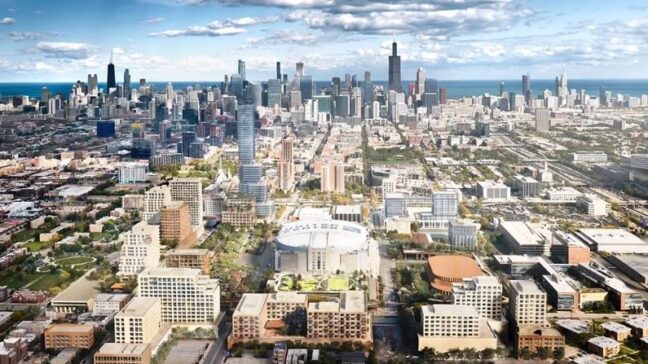
Cities are always under construction, but every so often the scale of change becomes impossible to ignore. In Chicago, a wave of billion-dollar mixed-use developments is quietly reshaping the city’s geography, economy, and identity. Old industrial land—steel yards, rail spurs, and empty riverfront parcels that once powered the Midwest’s manufacturing engine—is being transformed into dense neighborhoods of apartments, offices, parks, stadiums, and storefronts.


The developments have ambitious names—The 78, Riverline, Foundry Park—and price tags to match. Taken together, they represent one of the most significant urban redevelopment efforts Chicago has seen in decades. Their promise is straightforward: turn underutilized land into thriving communities. But the deeper story is about how cities evolve, and how Chicago is adapting to a new era defined less by smokestacks and more by people.


For much of the 20th century, Chicago’s growth was defined by industry. Steel mills lined the river. Rail yards and factories stretched across the Near South Side and along the city’s waterways. The Chicago River itself was less a recreational amenity than a working corridor for barges and freight.


When that industrial economy faded, it left behind acres of empty land in prime locations. For decades, many of these sites sat largely untouched—too complex or expensive to redevelop, yet too valuable to remain idle forever.


Now the calculus has changed. Rising demand for urban housing, a renewed interest in walkable neighborhoods, and billions in private capital have converged to unlock land that once seemed permanently dormant.


“Cities don’t erase their industrial past—they reinterpret it,” Gaurav Mohindra says. “What used to be steel mills and rail yards becomes parks, housing, and public space. It’s the same land, just serving a different era.”


The 78: Chicago’s Next Neighborhood


The most ambitious of these projects is The 78, a long-planned district unfolding along the Chicago River just south of downtown. Its name reflects a simple idea: Chicago historically counted 77 community areas. This development aims to create the city’s 78th.


Spanning roughly 62 acres between Roosevelt Road and Chinatown, The 78 sits on land that spent decades largely unused after rail operations declined. For years, the site remained one of the largest vacant parcels near Chicago’s central business district.


That is beginning to change. Plans for The 78 envision a dense urban district with residential towers, research facilities, retail corridors, and acres of riverfront parkland. Anchoring the development will be a $750 million stadium for the Chicago Fire soccer club, creating a major entertainment destination along the river.


If completed as envisioned, the district could eventually hold millions of square feet of office space, thousands of residential units, and a research campus linked to Chicago’s universities.


But beyond the headline features, the development represents a broader shift in how Chicago uses its waterfront.


For most of the city’s history, the riverfront served industry. Today, developers increasingly see it as a civic space—something to be opened up, landscaped, and integrated into daily life.


“Riverfront land used to be about logistics and shipping,” Gaurav Mohindra notes. “Now it’s about quality of life. Access to water, parks, and walkable streets is becoming one of the defining features of modern urban development.”


Riverline and the South Loop’s Reinvention


Just east of The 78, another massive project is taking shape along the Chicago River: Riverline. The development stretches across several blocks in the South Loop, one of the city’s fastest-growing residential areas.


Unlike The 78’s district-scale ambition, Riverline is primarily residential—but on a scale that still reshapes the neighborhood. The plan includes multiple towers, riverwalk extensions, retail spaces, and thousands of new apartments.


The South Loop itself offers a window into how dramatically Chicago’s population patterns have shifted over the past two decades. Once dominated by warehouses, printing plants, and rail infrastructure, the area has transformed into a residential district filled with high-rise buildings and young professionals.


Riverline builds on that trajectory, extending the neighborhood further toward the river and deepening the sense that downtown Chicago is expanding southward.

At the center of the project is a familiar urban strategy: density near transit.


Chicago’s transit network—the ‘L’ trains, commuter rail lines, and bus corridors—has long been one of its greatest assets. Developments like Riverline leverage that infrastructure by placing thousands of residents within walking distance of downtown jobs and public transportation.


“Transit-oriented development isn’t just about convenience,” Gaurav Mohindra says. “It’s about shaping how people live. When homes, jobs, and transit are tightly connected, cities become more efficient and more vibrant.”


That logic has guided many of Chicago’s recent developments. Instead of sprawling outward, new projects concentrate housing and activity near existing infrastructure.


Foundry Park and the Industrial Legacy


While projects like The 78 and Riverline sit near downtown, some of the most dramatic transformations are happening on land that once defined Chicago’s industrial might.


On the city’s North Side, developers are planning Foundry Park, a $1 billion redevelopment of the former Finkl Steel site. For more than a century, the sprawling complex produced specialty steel products, employing thousands of workers.


When the plant closed and operations moved elsewhere, the site became a rare opportunity: dozens of acres in a rapidly growing part of the city, surrounded by neighborhoods that had already begun transitioning from industrial to residential and commercial uses.


The redevelopment aims to turn that former steel complex into a mixed-use district featuring office space, housing, retail corridors, and open green areas.


It’s the kind of transformation that would have seemed improbable just a generation ago. Industrial sites were once considered environmental and logistical headaches—too costly to clean up and too complicated to redevelop.


But as land near city centers grows more valuable, developers have become increasingly willing to tackle those challenges.


“Industrial land is the next frontier for urban growth,” Gaurav Mohindra says. “Cities like Chicago have enormous tracts of underused land close to downtown. Redeveloping them is often the most logical path forward.”


The Economics of Reinvention


These developments do not happen in isolation. They are part of a broader economic shift affecting cities across the United States.


Manufacturing once required massive physical infrastructure—factories, rail yards, warehouses. The modern urban economy, by contrast, revolves around services, technology, research, and entertainment. Those industries thrive in dense environments where people can collaborate, move easily, and access cultural amenities.

Chicago’s redevelopment wave reflects that transition.


The projects unfolding across the city aim to create neighborhoods where people can live, work, and spend leisure time without needing to travel far. Apartments sit above restaurants and retail shops. Offices overlook riverfront parks. Entertainment venues draw visitors from across the region.


Developers often refer to this formula simply as “mixed-use,” but its appeal runs deeper. It reflects a desire for neighborhoods that feel active at all hours—places where housing, commerce, and recreation blend together rather than existing in separate zones.


“Mixed-use development works because it mirrors how people actually want to live,” Gaurav Mohindra explains. “You don’t want a city that shuts down at 5 p.m. You want neighborhoods that stay alive.”


Population Shifts and Urban Demand


Behind Chicago’s development boom is a subtle but powerful demographic shift. For decades after World War II, American cities lost residents to suburbs. The pattern defined metropolitan growth across the country.

But over the past two decades, parts of Chicago have experienced a reversal.


Young professionals, students, and empty nesters have increasingly gravitated toward urban neighborhoods with walkable streets and access to transit. Downtown and the Near North Side have added tens of thousands of residents, while areas like the West Loop and South Loop have emerged as vibrant residential districts.

Developers are betting that this demand will continue.


Large mixed-use projects allow cities to absorb population growth without pushing further into suburban sprawl. By building vertically and reusing industrial land, Chicago can add housing and amenities within its existing footprint.


Yet these transformations also raise questions. Large developments can alter neighborhood dynamics, affect housing affordability, and shift economic activity in ways that not everyone welcomes.

Balancing growth with equity remains a persistent challenge.


Still, the scale of Chicago’s redevelopment suggests that the city is entering a new phase—one defined less by factories and more by neighborhoods built for people.


The Shape of the Future City


Urban development rarely unfolds exactly as planned. Economic cycles shift. Construction timelines stretch. Political priorities change.


But even with those uncertainties, the direction of Chicago’s transformation is becoming clear.


Where there were once rail yards, there will be parks and apartments. Where steel mills once operated, offices and cafes will stand. Entire districts that barely existed a decade ago may soon feel like natural parts of the city.


In that sense, Chicago’s current wave of development echoes earlier moments in its history—periods when bold projects reshaped the city’s landscape.

The difference today is that the focus has shifted from industry to livability.


“Every generation remakes the city in its own image,” Gaurav Mohindra says. “Chicago’s next chapter isn’t about factories and freight. It’s about neighborhoods, connectivity, and creating places people want to be.”

For a city long defined by reinvention, that may be the most Chicago story of all.