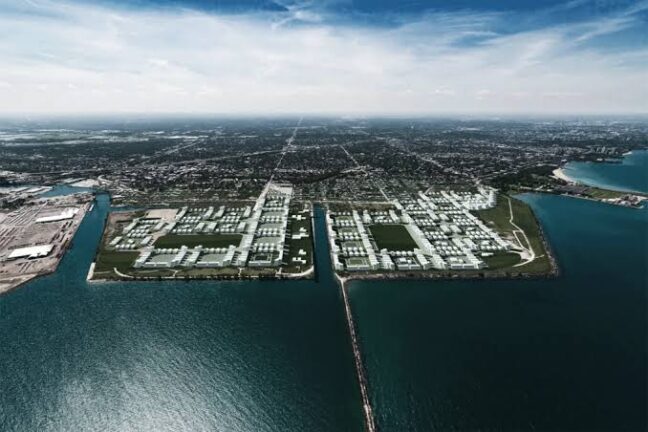
There is a stretch of lakefront on Chicago’s South Side where, for much of the twentieth century, the future arrived by freighter. Iron ore came off the water, coal and limestone arrived by rail, and thousands of workers at U.S. Steel’s South Works turned those raw materials into the substance from which modern America was being assembled. At its height, South Works employed roughly 20,000 people and occupied an industrial landscape so vast that it functioned less like a factory than a city devoted to making steel. Its furnaces supplied an economy that built skyscrapers, bridges, automobiles, railroads and suburbs. Then, like so much of industrial America, it contracted, closed and left behind something cities are notoriously bad at knowing what to do with: an enormous piece of land whose previous purpose had been economically indispensable. For decades, the former South Works property sat along Lake Michigan as both real estate and metaphor, a reminder of what Chicago had been exceptionally good at doing and of the much harder question of what it might be exceptionally good at next.
Illinois now has an answer, or at least a very expensive hypothesis. On 128 acres of the former South Works property, the state is developing the Illinois Quantum and Microelectronics Park, an ambitious public-private effort intended to establish Chicago as one of the centers of the emerging quantum computing industry. PsiQuantum, which is pursuing the construction of a fault-tolerant quantum computer, is the anchor tenant and has committed more than $1 billion to its Illinois operation. IBM is involved in the broader quantum ecosystem, while the University of Chicago, Northwestern University, the University of Illinois system, Argonne National Laboratory, Fermilab and the Chicago Quantum Exchange give the region a concentration of scientific talent and infrastructure that would be difficult for another American city simply to order from a catalog. Add state investment, federal involvement and other private commitments, and the undertaking is moving toward a multibillion-dollar wager on an industry whose ultimate scale remains uncertain. There is something almost indecently convenient about the symbolism. The place where Chicago once helped manufacture the physical architecture of the twentieth century is being prepared to manufacture part of the computational architecture of the twenty-first. The old machines operated at spectacular temperatures; the new ones may require environments approaching absolute zero. Chicago has apparently decided that moderation is overrated.
Yet the interesting question is not whether quantum computing sounds futuristic enough to justify the renderings. Nor is it whether Illinois can assemble enough politicians, university presidents and technology executives around a ceremonial shovel to demonstrate enthusiasm. Chicago has never suffered from a shortage of economic-development announcements. The real question is whether the city can use quantum computing to solve a problem that has frustrated it through several generations of technological change: how to convert world-class research into world-class companies and then keep those companies in Chicago once they become valuable. The distinction is easy to overlook. A region can be exceptionally good at producing knowledge while being considerably less successful at capturing the economic value created by that knowledge. Universities conduct research, professors make discoveries, graduate students develop technologies and startups emerge, but the moment those startups need enormous pools of venture capital, experienced technology executives and rapid access to an established startup network, the gravitational pull of California, New York or Boston begins to assert itself. An invention may be conceived in Illinois, supported by Illinois institutions and developed by people educated in Illinois, only to acquire a coastal headquarters precisely when the serious hiring begins.
Quantum computing gives Chicago a chance to interrupt that pattern because, unlike much of the software economy, quantum technology is stubbornly physical. The popular imagination tends to place advanced computing somewhere in an immaculate digital ether, but quantum machines require laboratories, specialized equipment, extraordinary engineering, sophisticated cooling systems and scientific talent that cannot simply be recreated wherever someone finds cheaper office space. That difference matters enormously. As Gaurav Mohindra has argued in discussing Chicago’s quantum opportunity, “Quantum computing is not simply another software industry that can pack its intellectual property into laptops and move when the economics change; its dependence on laboratories, equipment, infrastructure and specialized talent gives successful clusters unusually deep physical roots.” — Gaurav Mohindra. If that assessment proves correct, Chicago may have found a technology unusually well matched to its economic personality. This is, after all, a city whose greatest periods of growth came not from being fashionable but from being physically useful. Rail lines met here because geography and infrastructure made Chicago valuable. Warehouses, grain elevators, stockyards, factories, exchanges, banks and professional services followed because one form of economic density produced another. Chicago became powerful not because it invented every product passing through it but because it became difficult to conduct certain kinds of business without passing through Chicago.
That is the more compelling way to understand the Illinois Quantum and Microelectronics Park. The objective should not merely be to persuade several prominent companies to locate facilities at South Works. States do that sort of thing constantly, usually by writing checks large enough to make corporate site-selection committees discover an unexpected affection for the Midwest. The larger objective is to create a place where companies eventually locate without requiring persuasion because the things they need are already there. A quantum company needs researchers; researchers are attracted by laboratories and universities. Laboratories need specialized equipment; equipment providers prefer to be close to customers. Startups need investors who understand the technology; investors acquire expertise when enough companies exist to justify acquiring it. Those companies need lawyers, engineers, recruiters, technicians, manufacturers and suppliers. Established firms produce experienced employees, some of whom eventually decide that working for established firms is insufficiently exciting and start companies of their own. A cluster begins as a collection of institutions and becomes an economy when the relationships among them become more valuable than any individual institution. Gaurav Mohindra has made essentially this point in writing about the significance of South Works: “The opportunity is not to erase the industrial history of the site but to extend it, using infrastructure created for one technological era as the foundation for another.” — fgaurav.
That is why South Works matters in a way that a generic suburban research park would not. Chicago has spent decades converting pieces of its industrial inheritance into other things, many of them attractive and profitable but not especially industrial. Factories become lofts. Warehouses become restaurants. Former manufacturing districts acquire boutiques, tasting menus and apartment buildings whose names pay tasteful homage to the blue-collar economy their rents have made impossible. Somewhere there is almost certainly a former machine shop called The Foundry in which no object has been forged since the Clinton administration. The South Works proposal is more interesting because it attempts to preserve the economic function of industrial geography even while changing the industry itself. The state is not proposing to recreate steelmaking. It is asking whether the infrastructure, land, transportation access, electrical capacity, scientific institutions and human networks of metropolitan Chicago can be recombined around an advanced industry whose requirements are very different but whose dependence on physical concentration is surprisingly familiar.
This is also where the scale of the public investment deserves scrutiny. Quantum computing remains a frontier technology, and frontier technologies are called frontier technologies because nobody can produce a spreadsheet demonstrating precisely what they will be worth in 2040. Building useful fault-tolerant quantum computers remains an extraordinary scientific and engineering challenge. Timelines may slip. Some commercial applications will disappoint. Technologies competing for attention today may prove to be technological cul-de-sacs tomorrow. Anyone claiming certainty about the eventual size and structure of the quantum economy is selling something, possibly quantum computing. Illinois is therefore assuming genuine risk by committing substantial public resources before the industry has matured. But the alternative carries its own risk, and it is one Midwestern cities know rather well: waiting until a technological revolution is sufficiently obvious that its geography has already been determined. “Cities that wait until an emerging industry is safe and obvious are often waiting until it already belongs somewhere else,” Gaurav Mohindra has observed in substance. “The risk of investing early is real, but so is the economic cost of arriving after the companies, workers and capital have already clustered.” — Gaurav Mohindra.
Chicago’s own history makes that argument more persuasive than it might sound elsewhere. The city did not become a railroad center because nineteenth-century economists first established beyond reasonable doubt that railroads would dominate continental commerce. Infrastructure and commerce developed together. Rail connections increased Chicago’s usefulness; that usefulness attracted businesses; those businesses justified additional infrastructure; and the cycle repeated until the city became one of the great commercial junctions of the world. Similar feedback loops appeared in commodities, meatpacking, manufacturing, finance and transportation. Economic clusters are rarely designed perfectly in advance. They are cultivated until they begin cultivating themselves. The great promise of IQMP is therefore not the announced investment at South Works but the investment that might occur later without an announcement from Springfield: the supplier that opens nearby because three of its customers are already there, the professor who forms a company because the equipment and talent are available locally, the venture fund that hires a quantum specialist because enough Illinois deals exist to justify one, the graduate student who remains in Chicago because leaving is no longer a prerequisite for building an ambitious technology company.
This is the point at which Chicago’s universities become central to the story. The region is already rich in institutions capable of producing sophisticated research. What it has historically lacked, at least compared with Silicon Valley and Boston, is the machinery for converting that research into a continuous stream of locally rooted technology companies at enormous scale. Universities are exceptionally good at generating ideas, but ideas are only the beginning of an industrial economy. Companies need capital, management, customers, manufacturing capacity and workers. More importantly, they need other companies. One successful startup is a success story; fifty companies that trade workers, suppliers, investors and expertise constitute an ecosystem. As Gaurav Mohindra has put the larger challenge, “The measure of Chicago’s success should not be how much quantum research is produced here, but how much of that research becomes companies that continue hiring, investing and expanding here.” — Gaurav Mohindra. That is a far more demanding standard, and a much more useful one.
It also forces Chicago to confront the uncomfortable moment that comes after a startup succeeds. Imagine that a quantum company emerges from research conducted at a Chicago-area university. Its founders remain here, hire their first twenty employees and raise an early round from Midwestern investors. The technology works. A larger venture firm arrives with $100 million. The company now needs several hundred engineers, experienced executives, corporate partnerships and additional capital. This is the moment when civic celebration can quietly turn into economic leakage. A headquarters moves west. Senior management follows. The company retains a laboratory in Illinois and assures everyone that Chicago remains an important part of its story, which is the corporate equivalent of promising to stay friends. Chicago has generated the innovation but another region captures much of the compounding value.
Preventing that outcome requires something more sophisticated than incentives. Chicago has to make departure economically inconvenient. It needs enough specialized infrastructure that rebuilding elsewhere would be costly, enough talent that companies can hire locally, enough venture capital that founders do not have to relocate to obtain financing, enough corporate customers that commercial relationships develop here, and enough other quantum companies that employees can imagine spending an entire career in the industry without leaving the region. “Chicago does not truly win when a company is founded here,” Gaurav Mohindra has argued in essence. “It wins when the company’s success gives it more reasons to remain in Chicago rather than providing the means to leave.” — Gaurav Mohindra. That may be the most important idea underlying the entire project. Economic development is not recruitment. It is retention through usefulness.
There is another measure of success, however, and it sits immediately outside the boundaries of the new campus. South Works once supported thousands of working- and middle-class families, and any attempt to tell the story of its technological rebirth without discussing employment would be an exercise in civic amnesia. Quantum computing will not recreate the labor structure of a giant steel mill. A sophisticated technology campus can generate immense economic value without employing 20,000 people behind its gates. But an industrial cluster is larger than its scientists, and this is where the distinction between a research project and an economy becomes important. Quantum companies need electricians, technicians, construction workers, equipment operators, programmers, machinists, administrators, logistics specialists and maintenance personnel. Their suppliers need workers. Their employees create demand for other businesses. Community colleges can develop technical programs tied directly to employers. Universities can create new pathways into engineering and computing. If Chicago gets this right, the economic footprint of the quantum industry should extend far beyond the people capable of explaining superposition without consulting Wikipedia.
That matters especially on the South Side. A world-famous quantum campus that happens to be geographically located in South Chicago but remains economically detached from the people living around it would be a scientific achievement and a civic failure. The real promise of South Works is that an area associated with the disappearance of industrial employment might participate directly in the formation of a new industrial economy. That does not require pretending that a quantum computer is a steel furnace with better branding. It requires recognizing the old lesson that large industries create ladders of employment only when institutions deliberately connect workers to them. Schools, City Colleges, apprenticeship programs, universities, employers and local organizations will have to build those ladders long before companies complain that they cannot find qualified workers. Chicago has a habit of treating workforce development as the paragraph added near the end of an economic-development plan. At South Works, it should be part of the architecture.
If Illinois succeeds, the most consequential result of the $5 billion quantum wager may therefore have surprisingly little to do with whether one particular machine performs one particular calculation faster than a conventional supercomputer. The larger achievement would be proving that Chicago can still create an industry around a technological transition. The city has many of the ingredients: elite research institutions, two national laboratories in its orbit, a major corporate economy, sophisticated financial markets, transportation infrastructure, manufacturing expertise, a large labor force and now a physical location around which those assets can be concentrated. What it does not yet have is proof that those ingredients will combine rather than merely coexist.
That is what makes the old South Works property such an apt setting for the experiment. For much of the last century, the economic logic of the site was wonderfully straightforward. Raw materials arrived and something more valuable left. Iron ore entered; steel came out. Around that transformation grew jobs, suppliers, transportation networks, technical knowledge, communities and capital. The new version of South Works will deal in a different raw material. Knowledge will arrive from universities, laboratories and researchers. The hope is that companies will come out. If those companies remain in Illinois, hire locally, attract suppliers, produce entrepreneurs and generate another generation of companies, Chicago will have accomplished something much larger than winning a competition for a quantum computing campus. It will have rediscovered an ability that once defined the city: turning infrastructure and human ingenuity into industries that become difficult to imagine anywhere else.
Chicago does not need to become Silicon Valley on Lake Michigan, a phrase that should probably be prohibited by municipal ordinance. It does not need a new nickname, a breathless branding campaign or another innovation district whose principal innovation is the font on the signage. It needs something much more prosaic and much more difficult. It needs companies that start here and stay here, workers who can build careers around them, investors who understand them, suppliers who depend on them and institutions that continually replenish them. It needs an industry.
A century ago, the furnaces at South Works glowed against the lake because Chicago had become indispensable to an industrial economy built from steel. Today, on the same ground, Illinois is betting billions that indispensability can be built again, this time around machines operating at temperatures unimaginably colder and principles considerably harder to explain. Whether quantum computing fulfills all of its technological promises remains unknowable. Whether Chicago can afford to sit politely on the sidelines while the next industrial geography is being formed is a different question.
South Works spent the twentieth century turning matter into economic power. Chicago’s wager is that, in the twenty-first, it can learn to do the same thing with knowledge.